The WilmU program handbook: what it decides and what to look up
Wilmington University's College of Nursing and Health Sciences sends graduate students to the program handbook for one practicum detail above all: the point in your course progression when the background check and drug screen are due. WilmU's public program pages mention the handbook without linking it, so it is the document to read closely once it is in your hands. Here is what WilmU says it governs, how it differs from the public catalog, and which entries to find first.
Get your placement plan
Tell us your WilmU program and where you live. A placement advisor replies with the preceptor and site options that fit your WilmU course.
What WilmU says the handbook controls
The clearest public reference sits in the College's credentialing policy on background checks and drug screens. For undergraduates the timing is fixed: the first core course. For graduate NP, Leadership and DNP students, the checks go through the College's designated credentialing system ahead of any clinical experience, and the handbook's course progression sets exactly when. In other words, the handbook decides when your clearance clock starts.
That timing carries real weight. Under the same policy, a student who declines the checks, or whose finding is still open once the review ends, is barred from clinical courses, and that can stop progress through the whole program. The steps are laid out in the background check and drug screen guide, and the finished result, which WilmU calls clinical credentialing clearance, has a page of its own.
Handbook, catalog or program page: where each answer lives
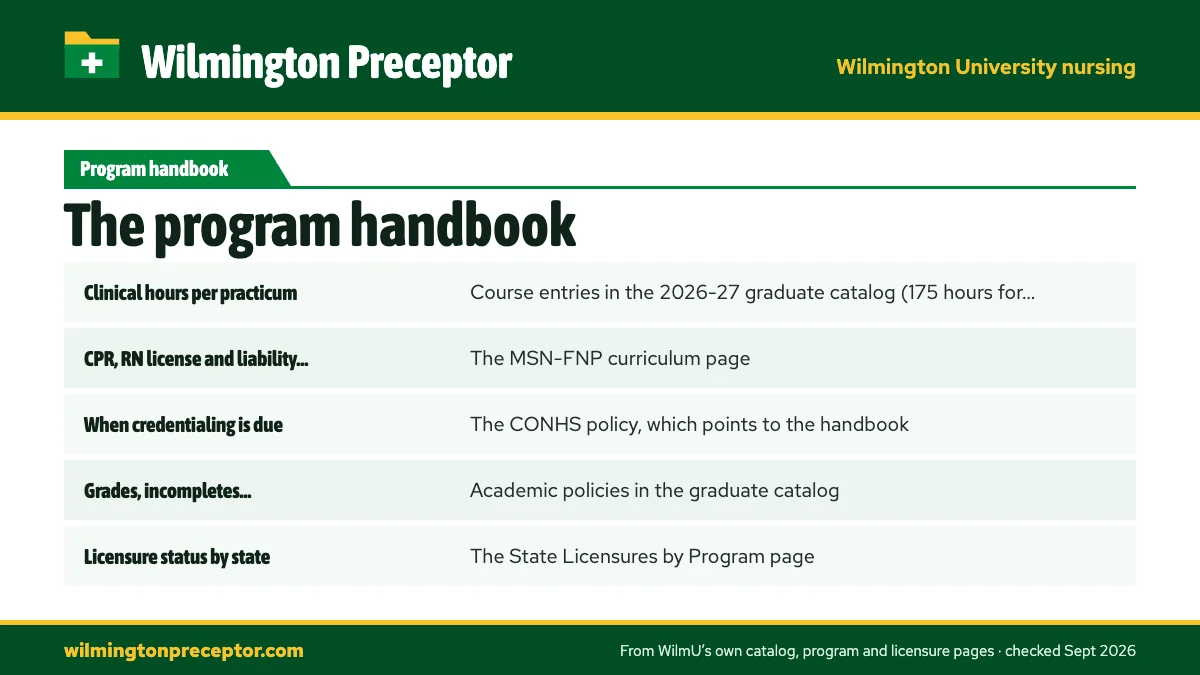
WilmU publishes its practicum rules in layers. Knowing which layer answers which question keeps you from hunting through the wrong document.
| Question | Public source | Look next |
|---|---|---|
| Clinical hours per practicum | Course entries in the 2026-27 graduate catalog (175 hours for GRN 7121, 225 for GRN 7124) | Handbook, for how hours are recorded |
| CPR, RN license and liability insurance | The MSN-FNP curriculum page | Handbook, for the proof you submit |
| When credentialing is due | The CONHS policy, which points to the handbook | Handbook course progression |
| Grades, incompletes, withdrawal, probation | Academic policies in the graduate catalog | Handbook, for any program-specific rule |
| Licensure status by state | The State Licensures by Program page | The Online Learning office |
| Preceptor approval, forms, lead times | Not on the public pages | Handbook, then the NP Program Chair or DNP Program Chair |
The catalog is public and published by academic year, which makes it the anchor for course numbers and hours. The handbook is where WilmU sends you for timing inside the program.
What to look up first
Several practicum details are absent from WilmU's public pages. If your edition of the handbook covers them, these are the entries to find and flag before your first practicum semester. If it does not, each one becomes a question for your chair.
Handbook checklist
- The exact course or term when clinical credentialing clearance must be complete
- Any form or step for proposing a preceptor or site, and who reviews it
- Lead times: how far ahead a site should be confirmed
- Preceptor qualifications beyond Delaware's rule for APRN program preceptors
- Whether an employer, a supervisor or a relative may precept you
- How clinical hours are logged, signed and evaluated
- Which immunization records graduate students provide
- Whether each NP practicum follows the 7-week block calendar or the full 15-week semester
- What happens if you move to another state mid-program
- What happens if a site ends a rotation early
Note the page or section numbers as you go. When you write to faculty later, quoting the section you are asking about gets a quicker, sharper answer. The open questions, sorted by the person who answers each one, are in questions for your program chair.
Reading the handbook against your course plan
Handbook timing only means something next to your own schedule. Pull up MyWilmU Degree Works, find your first practicum and circle its term. In the MSN-FNP, GRN 7121 Family Practicum I has four prerequisites (GRN 7104, GRN 7105, GRN 7101 and GRN 7103) and shares its semester with GRN 7107 and GRN 7106. In the PMHNP certificate, GRN 7221 runs alongside GRN 7203. DNP students look for GRN 8121 or GRN 9001, both of which list up-to-date credentialing as a prerequisite.
Then count backward from that term. Registration for each WilmU term opens weeks or months before classes, so the real deadline arrives sooner than the start date suggests. If the handbook puts credentialing ahead of the practicum term, your checks, your preceptor search and any facility onboarding all have to fit before the course begins. Registration windows, block dates and semester dates are on the academic calendar page.
When the handbook and a public page disagree
WilmU's public pages already disagree with one another in places, so expect the handbook to differ from something you have read. The MSN-FNP page lists its format as Online, yet it also mentions face-to-face seminars, two each year, for students in practicum. Older catalogs gave the FNP 600 and then 700 clinical hours, where the 2026-27 catalog gives 750. DNP curriculum pages give 500 hours for APRNs, while the DNP overview says 1,500.
Settle none of these by guesswork. Write to the chair who owns the topic, name both sources, and ask which one governs your cohort. Send it from your MyWilmU student email, the account WilmU's instructors, advisors and offices use, so the reply stays on record. The hour conflicts sit side by side on the clinical hours page.
Keep a record of your edition
Handbooks get revised, and the version in force when you reach your practicum may not match the one you read when you started. Write down the edition or date on the copy you rely on, save the sections on credentialing and practicum rules, and file faculty replies next to them. If a rule changes, you will know what changed and when.
RN to BSN students work from a different set of instructions. Their credentialing directions for NUR 303 are posted, per WilmU's catalog, in the Canvas site for BSN students, and the course itself is when the background check, drug screen and immunization record get done; earlier results are not accepted. Graduate students should not assume those undergraduate steps carry over to an NP or DNP program.
How we use your handbook in a preceptor search
Your handbook is the most WilmU-specific document you hold, so we build the search around it. Share the sections on preceptor qualifications, site rules and timing, and we screen every candidate against them, on top of Delaware's APRN preceptor licensing rule and the RN license your clinical state calls for.
The result is a preceptor and site that already fit the rules your program wrote, with the clinician's license, credentials and contact details in order before the practicum begins. That holds whether faculty are guiding your placement or you opened the search yourself. Each preceptor and site still goes to WilmU faculty for their decision, and what we hand over is built to clear that review without a second round. Send your details through the contact page.
Questions WilmU students ask
Is the WilmU nursing program handbook available online?
WilmU's public program pages and the College's credentialing policy refer to the program handbook without linking to it. If you are enrolled and cannot find your copy, ask your course faculty or the NP Program Chair where the current edition is kept, and record its date when you get it.
When do WilmU graduate nursing students complete the background check?
Ahead of their clinical experiences, on the schedule the program handbook's course progression sets. The checks go through the College's designated credentialing system, with fees paid by the student. GRN 8121, GRN 9001 and MSN 7752 each list completed credentialing or clinical clearance as a prerequisite.
Is the program handbook the same as the WilmU graduate catalog?
No. The graduate catalog is public, published for each academic year, and holds university-wide rules plus course entries with credits and clinical hours. The program handbook is the College document WilmU points to for program timing, such as when credentialing is due. Read both, and ask your chair when they seem to differ.
Do DNP and MSN Leadership students follow the program handbook too?
Yes for credentialing timing. The College's credentialing policy puts graduate NP, Leadership and DNP students on the same handbook-timed schedule. DNP students also see credentialing listed as a prerequisite for GRN 8121 and GRN 9001, and Educator-track students need clinical clearance before MSN 7752 starts.
What should I do if the handbook does not answer my question?
Write to the role that owns the answer: your track's Assistant Chair or the NP Program Chair for NP practicums, the DNP Program Chair for DNP hours, or the Online Learning office for state authorization. Name the handbook section you checked, so they can see exactly what is missing.
Related pages
Last checked 2026-09-27
We check these pages against Wilmington University's own program and curriculum pages, the 2026-27 graduate catalog, the College of Nursing and Health Sciences policies and the State Licensures by Program page. Your NP Program Chair, your course faculty and the College have the final word.
A WilmU practicum coming up? Your preceptor search starts here.
Tell us your WilmU program, where you live and when your next practicum starts. Whether WilmU's faculty help with your placement or you are starting the search yourself, we find preceptors who fit the course, check the health system's own intake steps, and organize the preceptor's license and credentials well before the first day.
- Preceptors matched to the course: family practice across the lifespan for
GRN 7121toGRN 7124, psychiatric mental health forGRN 7221toGRN 7224, doctorally prepared for the DNP - Clinicians who meet Delaware's rule for APRN program preceptors: an active APRN, PA, pharmacist or physician license in a comparable focus
- Close to home, in a state where you hold an RN license, with each system's onboarding mapped out early
Start your placement plan
Program, city and semester is all we need to begin.