The WilmU nursing background check and drug screen, step by step
Every Wilmington University student in the College of Nursing and Health Sciences completes a background check and a drug screen through the College's designated credentialing system, and pays the fees that go with them. Undergraduates do it in their first core course. Graduate NP, Leadership and DNP students do it before clinical experiences, at the point their program handbook sets. This guide takes the policy one step at a time.
Get your placement plan
Tell us your WilmU program and where you live. A placement advisor replies with the preceptor and site options that fit your WilmU course.
Why the College asks for it
The policy gives its own reasons. It exists to "meet requirements of clinical facilities and contractual agreements; and avoid delays in clinical placement." Put simply, hospitals and practices set conditions for the students they host, the College's written agreements with them carry those conditions, and a check finished early keeps them from holding up your start.
"Contractual agreements" points to the written arrangements between a school and a clinical facility. The affiliation agreements guide explains why health systems ask about them before anything else.
The policy reaches every CONHS student, graduate and undergraduate, so the same College process serves an RN to BSN student in NUR 303 and a DNP student heading into GRN 9001, on different timelines. It is also the heart of what WilmU calls clinical credentialing clearance, the status its catalog checks before clinical courses.
Who completes it, and at what point
Timing depends on your program. The policy fixes undergraduate timing to a course and graduate timing to the program handbook, and a few catalog entries add their own wording.
| Student group | When it is due | Where the details live |
|---|---|---|
| RN to BSN | The first core course, NUR 303 | The BSN student Canvas site |
| MSN-FNP, FNP and PMHNP Graduate Certificates, BSN to DNP | Before clinical experiences, at the point the course progression in the program handbook sets | The program handbook; the NP Program Chair or the Assistant Chair for FNP or PMHNP |
| MSN Leadership and Nursing Leadership Graduate Certificates | Before clinical experiences; MSN 7752 and the certificate clinical courses list clearance | The program handbook; the Chair or Assistant Chair for RN to BSN and MSN Leadership |
| DNP, Advanced Practice and Leadership | Before clinical experiences; GRN 8121 and GRN 9001 list up-to-date credentialing | The program handbook; the DNP Program Chair and your DNP Project Advisor |
RN to BSN students also hand in an immunization record and pay a one-time vendor fee during NUR 303; the NUR 303 credentialing page covers that course from start to finish.
The policy, one step at a time
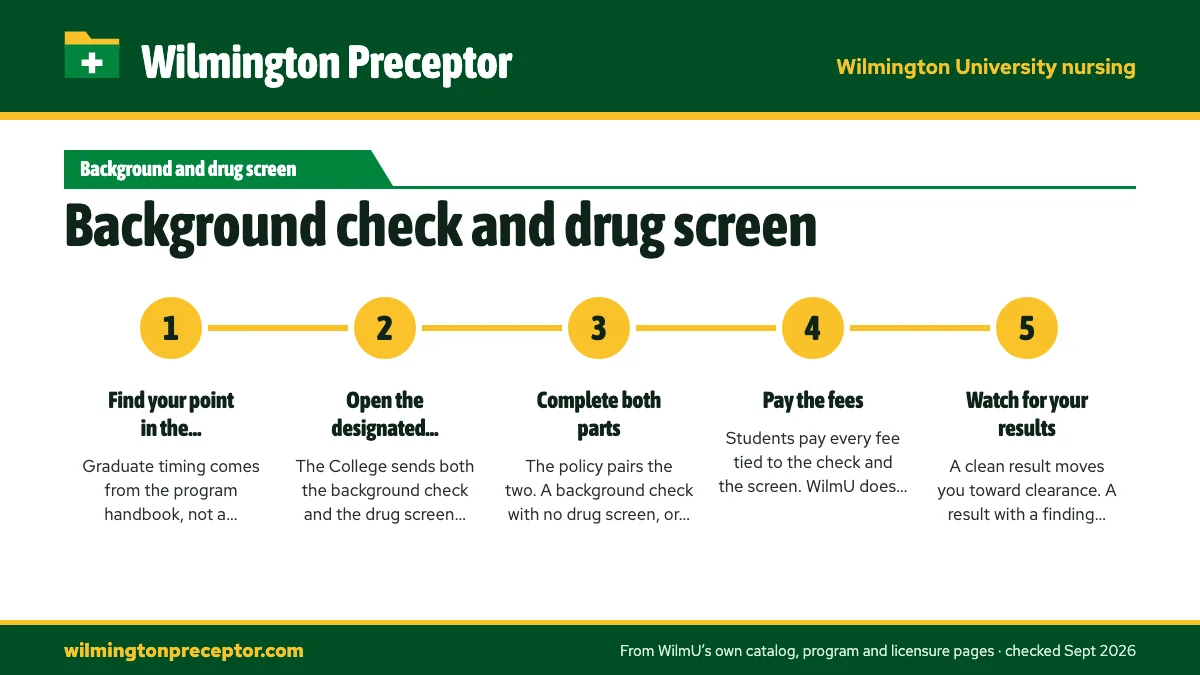
- Find your point in the progressionGraduate timing comes from the program handbook, not a calendar date. Look up where your program places the check and how that lines up with your first clinical course.
- Open the designated credentialing systemThe College sends both the background check and the drug screen through one designated system. Its vendor is not named on WilmU's public pages, so use the access details your program provides.
- Complete both partsThe policy pairs the two. A background check with no drug screen, or a screen with no check, leaves the requirement open.
- Pay the feesStudents pay every fee tied to the check and the screen. WilmU does not publish the amounts; the placement costs guide lists each cost that falls to WilmU students, without figures.
- Watch for your resultsA clean result moves you toward clearance. A result with a finding goes to review before any decision about clinical courses; the findings review guide explains that process.
- Confirm clearance before the courseMake sure the College shows you as cleared before the clinical course that lists it, and keep copies of what you submitted in case a site asks.
What the policy leaves to the handbook and your program
The public policy sets the rule and the review. The working details sit elsewhere, and they are worth asking about before you open the credentialing system for the first time.
- The credentialing vendor's name and how to set up access to it.
- What the fees come to and how they are paid.
- Which substances the drug screen covers, and how to document a prescribed medication.
- How long a result stays current, which matters because the DNP course entries ask for credentialing that is up to date.
- Whether a second check is needed before a later practicum or after a break in enrollment.
- What the College treats as a finding that goes to review.
Put these to the leader who fits your program, whether that is your track's Assistant Chair, the NP Program Chair or the DNP Program Chair, and keep the answers with your practicum notes so you are not asking twice.
Refusing, or a finding that stays open
The policy is direct about consequences. A student who refuses the check, or whose findings remain unresolved after review, cannot take clinical courses and may be unable to complete the program.
For an MSN-FNP student, that puts the 750 clinical hours of GRN 7121 through GRN 7124 out of reach. For a PMHNP certificate student it is GRN 7221 through GRN 7224, and for a DNP student the experiential engagement and project courses. A finding is not the same as a failed check, though: the policy puts a review in between, and a prompt, well-documented response gives that review what it needs.
Refusing the check, or leaving a finding unresolved after review, closes clinical courses under the College's policy, and with them the path to finishing the program.
Checks that come after the College's
WilmU's check is one of several you may meet. Beebe Healthcare's student page lists its own screening for NP and PA students: background, drug testing, fit testing, vaccines and a search of the Delaware Adult and Child Protection Registry, all finished in Clinician Nexus before the rotation. Bayhealth also runs student clearance through Clinician Nexus.
Licensure brings another. Delaware's Division of Professional Regulation asks APRN applicants for a State of Delaware and FBI criminal background check done specifically for that application, plus a self-query of the National Practitioner Data Bank. The licensing sequence is laid out in our guide to Delaware APRN practice.
Each check answers to a different body. A clean result for the College covers the College's requirement, and the site and the Board each ask their own questions on their own schedule.
Where our service fits
We are specialists in WilmU's clinical courses, and this check is built into every placement plan we write. Whatever part WilmU faculty play in arranging your practicum, we set the search timeline around the point your handbook names, line up sites whose own intake you can finish in time, and keep your preceptor's license and credentials organized next to your clearance items.
The decision on every preceptor and site belongs to WilmU faculty. Our part is a package with no gaps, so a missing page never becomes the reason a start date slips. Pick your program and term in the message form further down, add the date your first clinical course begins, and we will map the credentialing and intake dates with you.
Questions WilmU students ask
Who pays for the WilmU nursing background check and drug screen?
You do. The College's written policy puts all related fees on the student, and RN to BSN students pay a one-time outside vendor fee inside NUR 303. WilmU's public pages leave out the amounts, so check the credentialing instructions for your program or ask your program chair for the current figure.
Do WilmU graduate students complete the background check at admission?
The policy ties graduate timing to clinical work rather than to admission. Graduate NP, Leadership and DNP students complete the check and the screen before clinical experiences, at the point their program handbook sets. Undergraduates follow a different rule and complete both in their first core course.
Will a hospital accept WilmU's background check in place of its own?
Each health system sets its own intake. Beebe Healthcare, for example, lists its own background and drug testing within Clinician Nexus onboarding for NP and PA students. Treat the site's steps as a separate item on your list, and ask the site's student coordinator what it accepts from the school.
How long does a WilmU background check stay valid?
WilmU's public pages do not give a validity period. The catalog entries for GRN 8121 and GRN 9001 ask for credentialing that is completed and up to date, which suggests currency matters. Ask the program chair for your track how long a result counts and whether a later practicum calls for a new one.
What does the WilmU nursing drug screen test for?
The public policy does not list the panel. It says only that CONHS students complete a drug screen through the designated credentialing system. If you take a prescribed medication, ask your program coordinator how to document it before the screen, since the policy includes a medical reviewer among those who look at findings.
Related pages
Last checked 2026-09-27
We check these pages against Wilmington University's own program and curriculum pages, the 2026-27 graduate catalog, the College of Nursing and Health Sciences policies and the State Licensures by Program page. Your NP Program Chair, your course faculty and the College have the final word.
A WilmU practicum coming up? Your preceptor search starts here.
Tell us your WilmU program, where you live and when your next practicum starts. Whether WilmU's faculty help with your placement or you are starting the search yourself, we find preceptors who fit the course, check the health system's own intake steps, and organize the preceptor's license and credentials well before the first day.
- Preceptors matched to the course: family practice across the lifespan for
GRN 7121toGRN 7124, psychiatric mental health forGRN 7221toGRN 7224, doctorally prepared for the DNP - Clinicians who meet Delaware's rule for APRN program preceptors: an active APRN, PA, pharmacist or physician license in a comparable focus
- Close to home, in a state where you hold an RN license, with each system's onboarding mapped out early
Start your placement plan
Program, city and semester is all we need to begin.