Wilmington University's MSN-FNP and its 750 clinical hours
WilmU's Master of Science in Nursing, Family Nurse Practitioner track (MSN-FNP) is a 55-credit online program that builds toward four Family Practicums worth 750 clinical hours. Those practicums arrive in the second half of your studies, so your first year is the right time to think about who will precept you in GRN 7121. This guide covers the courses, the open questions on WilmU's own pages, and how we get you ready.
Get your placement plan
Tell us your WilmU program and where you live. A placement advisor replies with the preceptor and site options that fit your WilmU course.
The MSN-FNP at a glance
The College of Nursing and Health Sciences offers exactly one nurse practitioner master's, and this is it. The 55 credits divide into 16 core and 39 FNP credits, with room to bring in as many as 12 by transfer. New cohorts open each Fall and Spring, and everything must be finished inside five years.
The table gathers the program facts that shape clinical planning, drawn from WilmU's curriculum, overview and admission pages.
| Item | What WilmU publishes |
|---|---|
| Credits | 55 (16 core, 39 FNP); up to 12 transfer credits |
| Delivery | Online in the format list; the overview also describes two face-to-face seminars a year for practicum students |
| Length | 24 months on the curriculum page and in the catalog; 7 semesters on the overview |
| Start terms | Fall (apply by May 1, classes begin in August) and Spring (apply by October 1, classes begin in January) |
| Clinical hours | 750, with planned simulation counted inside the total |
| Certification | Family Nurse Practitioner through ANCC or AANPCB |
| Time limit | Five years; missing more than one year of study means repeating selected courses |
One more rule runs through the whole track: MSN-FNP students hold a 3.0 GPA from the first course onward, not only at graduation.
Where the four Family Practicums fall
The practicums occupy the back half of the plan. Family Practicum I (GRN 7121) waits until you have passed GRN 7101 and GRN 7103 along with the assessment pair, GRN 7104 and GRN 7105, and it shares its semester with GRN 7106 and GRN 7107. Practicums II, III and IV then come one after another.
Two earlier courses already put your hands to work. In GRN 7104, advanced health assessment for every age group is taught in a lab setting, and its companion, GRN 7105, builds differential diagnosis and clinical decision-making in that same term. Our guide to those lab-based courses explains why they are the last checkpoint before direct patient care.
| Course | Direct care hours | Placement in the plan |
|---|---|---|
GRN 7121 Family Practicum I | 175 | After GRN 7101, GRN 7103, GRN 7104 and GRN 7105; with GRN 7106 and GRN 7107 |
GRN 7122 Family Practicum II | 175 | Follows Practicum I |
GRN 7123 Family Practicum III | 175 | Follows Practicum II |
GRN 7124 Family Practicum IV | 225 | Final practicum |
Two scheduling details are missing from WilmU's pages: a part-time plan, and whether each practicum runs as a seven-week block or a full semester. Confirm the exact term for each one in Degree Works and with the NP Program Chair.
Three published discrepancies to settle early
WilmU's own pages disagree with each other on a few points about this program, and each one touches how you budget clinical time. None is cause for alarm. Put each to the NP Program Chair, or to the FNP Assistant Chair, well before your practicum year.
- Delivery. The overview's format list says Online only, yet the same overview describes live virtual class sessions and, for students in practicum, in-person seminars twice each year. It does not say where they meet.
- Length. The curriculum page and catalog say 24 months; the overview says 7 semesters.
- Hours over time. The 2021-22 catalog listed 600 clinical hours in four 120-hour practica, and the 2024-25 catalog listed 700. Today's catalog lists 750, so advice from earlier graduates may undercount.
Our simulation and seminars page looks at the seminar question in detail, and the 750-hour guide traces how the total grew.
What has to be in place before GRN 7121
Your first practicum rests on requirements that start well before the course opens. WilmU's name for the finished state is clinical credentialing clearance, and it is built from these pieces:
- The College's background check and drug screen, completed in its designated credentialing system whenever the program handbook calls for it. You cover those fees.
- Current CPR (cardiopulmonary) certification.
- An RN license valid in whichever state hosts your clinical hours.
- Enrollment under WilmU's group professional liability policy, which the University provides for NP students.
- Any associated course fee: WilmU notes that some FNP courses carry one, without naming which.
Each item has its own guide here. Start with clinical credentialing for clearance and timing, and read the RN license rule if your clinical site could be in a different state from the one that licensed you.
The preceptor a Family Practicum calls for
WilmU's public pages do not spell out NP preceptor credentials, so the working standard for a Delaware program comes from the Delaware Board of Nursing. Under its APRN program rules, the preceptor is a physician, PA, pharmacist or APRN whose license is active and unencumbered and whose practice focus is comparable to yours. Faculty approve each one, and each is briefed on the curriculum and on every course's objectives.
For a family track, comparable focus points toward clinicians who treat patients across the lifespan: family nurse practitioners, family physicians and other primary care providers with a broad age mix. However your placement comes together, with faculty assisting or with you opening the search yourself, our FNP preceptor search guide shows what a strong match looks like for each of the four practicums.
The Board adds that faculty need not be on site while a preceptor teaches you, and that grading stays in faculty hands. That makes a preceptor who understands WilmU's course objectives from day one worth more than a convenient address.
Planning the 750 hours from your first term
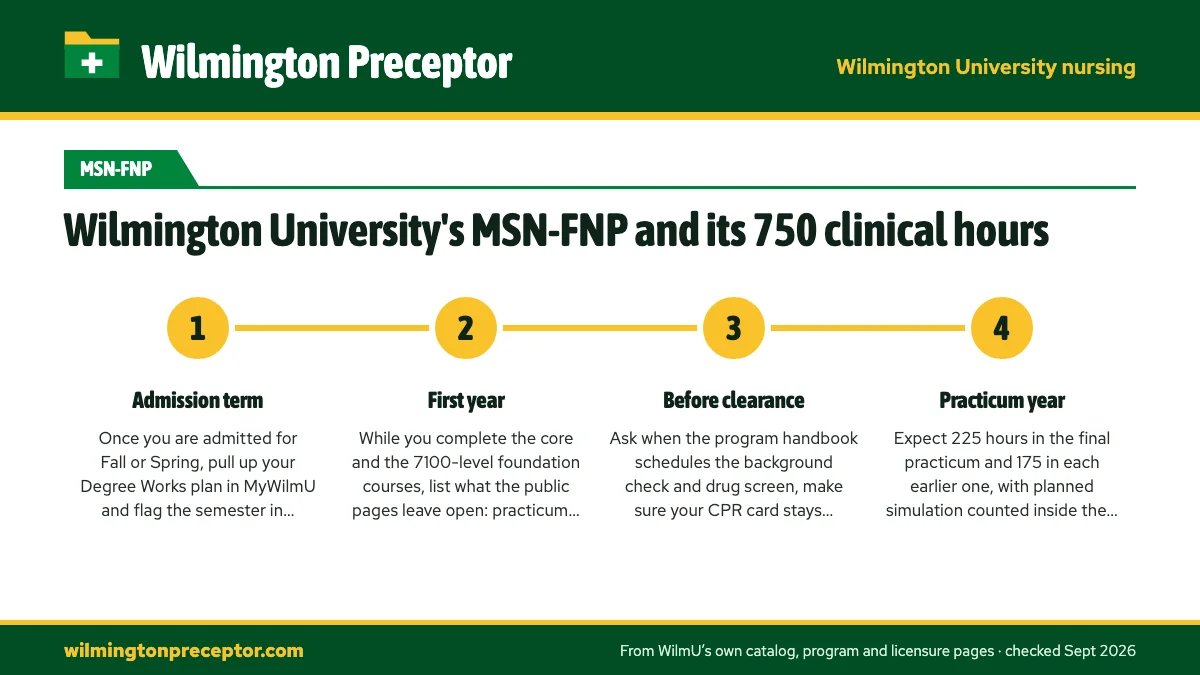
Because the practicums come late, the students who move through them calmly are usually the ones who plan from the start. A simple order of work:
- Admission termOnce you are admitted for Fall or Spring, pull up your Degree Works plan in MyWilmU and flag the semester in which
GRN 7106andGRN 7107sit beside Practicum I. - First yearWhile you complete the core and the 7100-level foundation courses, list what the public pages leave open: practicum term length, the seminar location, and how hours are logged.
- Before clearanceAsk when the program handbook schedules the background check and drug screen, make sure your CPR card stays current through the practicum year, and confirm your RN license covers the state where you hope to train.
- Practicum yearExpect 225 hours in the final practicum and 175 in each earlier one, with planned simulation counted inside the 750.
For the questions worth raising with faculty, see questions for your program chair.
Why MSN-FNP students choose us
We specialize in WilmU's family track. Our search targets clinicians whose practice fits the lifespan scope of GRN 7121 through GRN 7124, in the part of the map where you actually live and only in states where your RN license is valid. Every candidate's license is compared with Delaware's comparable-focus standard before a name goes to your faculty.
We gather the preceptor's credentials and contact details into one organized file, map any health-system intake early (Clinician Nexus, in the case of ChristianaCare, Bayhealth and Beebe), and stay with you through all four practicums. If a preceptor has to step away mid-course, we start on a replacement right away. Approval of every preceptor and site rests with WilmU faculty, and what we send them is complete from the first page.
Share your start term and ZIP code through the contact form and we will sketch your practicum year with you.
Questions WilmU students ask
Is WilmU's MSN-FNP fully online?
Mostly, with one open question. The program's format list says Online only, while the overview describes live online class sessions and, once you are in the practicums, two in-person seminar meetings per year. WilmU does not say where they are held. If travel would be hard for you, check with the NP Program Chair how your cohort handles the seminars before you settle on a start term.
How long does the WilmU MSN-FNP take?
WilmU gives two answers. The curriculum page and the catalog say it can be completed in 24 months, and the program overview says 7 semesters. In either case the five-year limit applies, and a gap of more than one year of study means repeating selected courses. Your Degree Works plan shows the path for your own cohort.
Which certification exam does the MSN-FNP prepare me for?
The program prepares you for Family Nurse Practitioner certification through either ANCC or AANPCB. If you plan to practice in Delaware, the state's APRN license itself carries full practice and prescriptive authority, with no collaborative agreement needed. Prescribing controlled substances there also takes a Delaware controlled substance registration, after a one-hour course, and a DEA registration.
Can I complete MSN-FNP clinicals outside Delaware?
WilmU ties clinicals to holding an RN license in the state where you complete them, and its state authorization page counts field experiences outside Delaware as online learning, with a promise to honor each state's rules for those experiences. Licensure after graduation is a separate matter: WilmU's State Licensures by Program listing shows the MSN-FNP as Not Determined Yet for New York, New Hampshire, North Dakota, Louisiana, Tennessee, Idaho and Wyoming.
Which admission requirements matter later for clinicals?
WilmU looks for a bachelor's in nursing from a nationally accredited program with at least a 3.0 GPA, a B or better in an undergraduate health assessment course, and an unencumbered RN license, along with a resume, a statement of goals and a Zoom interview. A statistics course comes before GRN 8102. The unencumbered license carries the most weight later, since every practicum depends on it.
Related pages
Last checked 2026-09-27
We check these pages against Wilmington University's own program and curriculum pages, the 2026-27 graduate catalog, the College of Nursing and Health Sciences policies and the State Licensures by Program page. Your NP Program Chair, your course faculty and the College have the final word.
A WilmU practicum coming up? Your preceptor search starts here.
Tell us your WilmU program, where you live and when your next practicum starts. Whether WilmU's faculty help with your placement or you are starting the search yourself, we find preceptors who fit the course, check the health system's own intake steps, and organize the preceptor's license and credentials well before the first day.
- Preceptors matched to the course: family practice across the lifespan for
GRN 7121toGRN 7124, psychiatric mental health forGRN 7221toGRN 7224, doctorally prepared for the DNP - Clinicians who meet Delaware's rule for APRN program preceptors: an active APRN, PA, pharmacist or physician license in a comparable focus
- Close to home, in a state where you hold an RN license, with each system's onboarding mapped out early
Start your placement plan
Program, city and semester is all we need to begin.