Wilmington University's BSN to DNP Family Nurse Practitioner track, from practicum to DNP project
WilmU's BSN to DNP Family Nurse Practitioner track takes a bachelor's-prepared nurse all the way to a doctorate: 75 credits in 24 online courses over about 3.5 years. You complete the same 750 hours of Family Practicums as the MSN-FNP, then move into DNP practice hours and the three-course DNP Project. That means two very different preceptor profiles, and this guide shows how to plan for both.
Get your placement plan
Tell us your WilmU program and where you live. A placement advisor replies with the preceptor and site options that fit your WilmU course.
The track in brief
WilmU runs the BSN to DNP FNP track online, with cohorts opening each Fall and Spring. Because you are entering two programs at once, you satisfy two sets of entry rules, the NP program's and the DNP program's, rather than one.
| Item | What WilmU publishes |
|---|---|
| Credits and courses | 75 credits in 24 courses |
| Length | About 3.5 years |
| Delivery and starts | Online; cohorts begin in Fall and Spring |
| Admission | Requirements of both the NP program and the DNP program |
| Clinical hours | 750 FNP hours plus additional DNP practice experience hours; no combined total is given |
| Year-by-year plan | Not published; your course plan comes through advising and MyWilmU Degree Works |
Compared with the PMHNP version of the same pathway, the FNP track is four credits and one course shorter. The BSN to DNP PMHNP guide covers that option.
Two phases, two kinds of clinical work
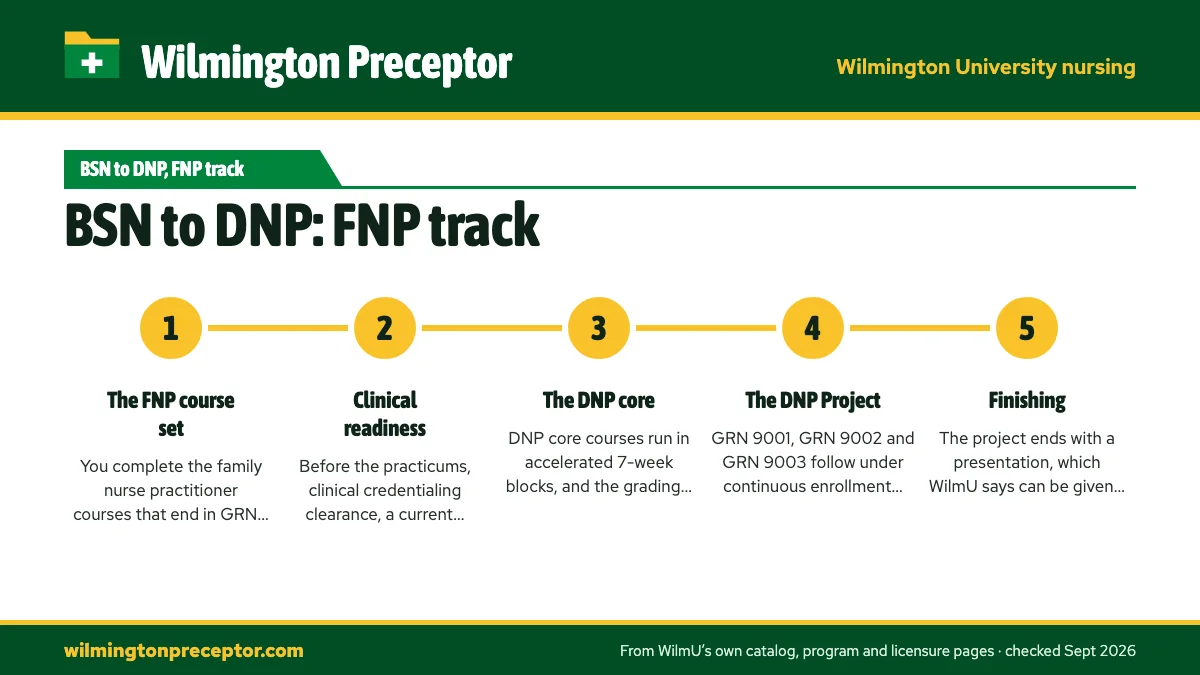
The track moves through two distinct stages, and the clinical work in each looks nothing alike. Here is the order WilmU's catalog sets out:
- The FNP course setYou complete the family nurse practitioner courses that end in
GRN 7121throughGRN 7124, the four Family Practicums, for 750 hours including planned simulation. The MSN-FNP guide details the prerequisites for Practicum I. - Clinical readinessBefore the practicums, clinical credentialing clearance, a current CPR card and an RN license for the state of your clinical site all come into play.
- The DNP coreDNP core courses run in accelerated 7-week blocks, and the grading standard rises to a B in every DNP course.
- The DNP Project
GRN 9001,GRN 9002andGRN 9003follow under continuous enrollment.GRN 9001takes a full 15-week semester, the later two each fit a 7-week block, andGRN 9001lists current, completed credentialing among its prerequisites. - FinishingThe project ends with a presentation, which WilmU says can be given virtually or on campus.
The hours: what is stated and what is not
WilmU states the hours for each course but not for the whole track. The table shows what the catalog gives per course.
| Stage | Hours stated by WilmU |
|---|---|
GRN 7121 to GRN 7123, Family Practicums I to III | 175 each |
GRN 7124 Family Practicum IV | 225 |
GRN 9001 DNP Project I | About 145 |
GRN 9002 DNP Project II | About 145 |
GRN 9003 DNP Project III | About 150 |
| Whole BSN to DNP track | Not stated: 750 FNP hours plus additional DNP practice experience hours |
Other figures float around the DNP. The GRN 9003 entry makes 1,000 practice hours beyond the bachelor's a condition of graduating, the DNP curriculum page gives 500 hours for advanced practice nurses, and the DNP overview says 1,500. None of those is written specifically for BSN to DNP students, so ask the DNP Program Chair how your family practicum hours and project hours are counted together. The DNP practice hours guide lines the competing numbers up.
Two preceptor profiles across 3.5 years
In the FNP phase, the Delaware Board of Nursing's APRN program rule sets the bar: a PA, APRN, physician or pharmacist license, active and unencumbered, with a comparable practice focus. For family practice, that means clinicians caring for patients across the lifespan. Faculty approve each preceptor and remain responsible for evaluation.
The DNP phase changes the profile. WilmU's DNP curriculum page pairs each doctoral student with an experiential engagement preceptor who holds a doctorate, and it notes that most projects happen where the student already works. Depending on the project, that preceptor could be a DNP-prepared clinician, a doctorally prepared nurse leader or another doctorally prepared professional in your setting; WilmU's public pages do not narrow it further.
It helps to plan both at once. If one of your family practicum preceptors holds a doctorate, ask faculty whether that relationship could continue into the project stage. Our FNP preceptor search guide and the page on DNP preceptor requirements cover each profile.
The DNP Project and the Human Subjects Committee
The project spans GRN 9001 to GRN 9003, with continuous enrollment across all three. Approval of your project plan by WilmU's Human Subjects Committee happens inside GRN 9001, and every doctoral student gets an assigned DNP Project Advisor to guide the work.
Three and a half years is long enough for jobs to change. Since the project usually lives inside a workplace, choose a setting where you expect to stay through GRN 9003; a move mid-project can put the continuous-enrollment requirement under strain. Talk with your DNP Project Advisor as soon as your workplace plans shift.
The DNP project courses guide takes each of the three courses in turn, including how the semester and block formats affect the hours you plan per week.
Where the licensure table places BSN to DNP
WilmU's State Licensures by Program table has a single BSN-DNP row that covers both the FNP and PMHNP tracks. It reads Not Determined Yet in nine states: Washington, Arizona, New York, Tennessee, North Dakota, Louisiana, Idaho, New Hampshire and Wyoming. That is two more than the MSN-FNP row, because Arizona and Washington are undetermined only for BSN to DNP.
The table speaks to licensure after graduation rather than to where clinicals may happen; for clinicals, what counts is an RN license in the state where each experience takes place. If you live in one of the nine states, take it to the Online Learning office, WilmU's contact point for state authorization, before you enroll. The licensure table guide shows every program's row.
Why BSN to DNP students choose us
A BSN to DNP student needs a family practice match for four practicums and then a doctorally prepared match for the project years. We plan both from your first term. For the practicums, our search covers lifespan clinicians near your home, limited to states where your RN license is valid, each screened against Delaware's comparable-focus standard. For the doctoral stage, we target doctorate-holding clinicians and nurse leaders in settings that suit the project you have in mind.
Every preceptor's credentials and contact details come to you organized, and health-system intake steps are mapped early. If someone drops out partway, the replacement search starts immediately. Every preceptor and site still goes to WilmU faculty for approval, and our files arrive with nothing missing. Tell us where you are in the track through the contact form.
Questions WilmU students ask
How long is WilmU's BSN to DNP FNP track?
WilmU gives about 3.5 years for 75 credits in 24 courses, with cohorts starting in Fall and Spring. A year-by-year plan is not public, so the exact term of each Family Practicum and each project course comes from Degree Works in MyWilmU and from your advisors.
Is the BSN to DNP FNP program online?
WilmU lists the track as online. The DNP pages describe the doctoral portion as fully online, with no residency on campus and two optional live meetings in each course. The practicum phase shares its courses with the MSN-FNP, whose overview refers to twice-yearly in-person seminars during the practicum stage, so ask whether those seminars apply to your cohort.
What grades does the BSN to DNP track require?
WilmU graduate degrees call for a 3.0 cumulative GPA or higher. In DNP courses the floor is a B: you may retake a DNP course once, and only two DNP courses in total may be repeated. That DNP rule is stricter than the university-wide policy, which allows up to four attempts at a course.
Can my DNP project be done at my job?
Often, yes. According to the DNP curriculum page, most WilmU DNP projects take place in the student's own workplace, guided by a doctorally prepared preceptor. The Human Subjects Committee still reviews the plan during GRN 9001, so bring your employer into the conversation well before that course begins.
Who advises BSN to DNP students?
WilmU splits advising for BSN to DNP students between the NP Program Chair and the leader of the DNP program, and each student also receives a DNP Project Advisor for the project courses. For family practicum questions, the FNP Assistant Chair is another useful contact.
Related pages
Last checked 2026-09-27
We check these pages against Wilmington University's own program and curriculum pages, the 2026-27 graduate catalog, the College of Nursing and Health Sciences policies and the State Licensures by Program page. Your NP Program Chair, your course faculty and the College have the final word.
A WilmU practicum coming up? Your preceptor search starts here.
Tell us your WilmU program, where you live and when your next practicum starts. Whether WilmU's faculty help with your placement or you are starting the search yourself, we find preceptors who fit the course, check the health system's own intake steps, and organize the preceptor's license and credentials well before the first day.
- Preceptors matched to the course: family practice across the lifespan for
GRN 7121toGRN 7124, psychiatric mental health forGRN 7221toGRN 7224, doctorally prepared for the DNP - Clinicians who meet Delaware's rule for APRN program preceptors: an active APRN, PA, pharmacist or physician license in a comparable focus
- Close to home, in a state where you hold an RN license, with each system's onboarding mapped out early
Start your placement plan
Program, city and semester is all we need to begin.