Wilmington University's BSN to DNP Psychiatric Mental Health NP track
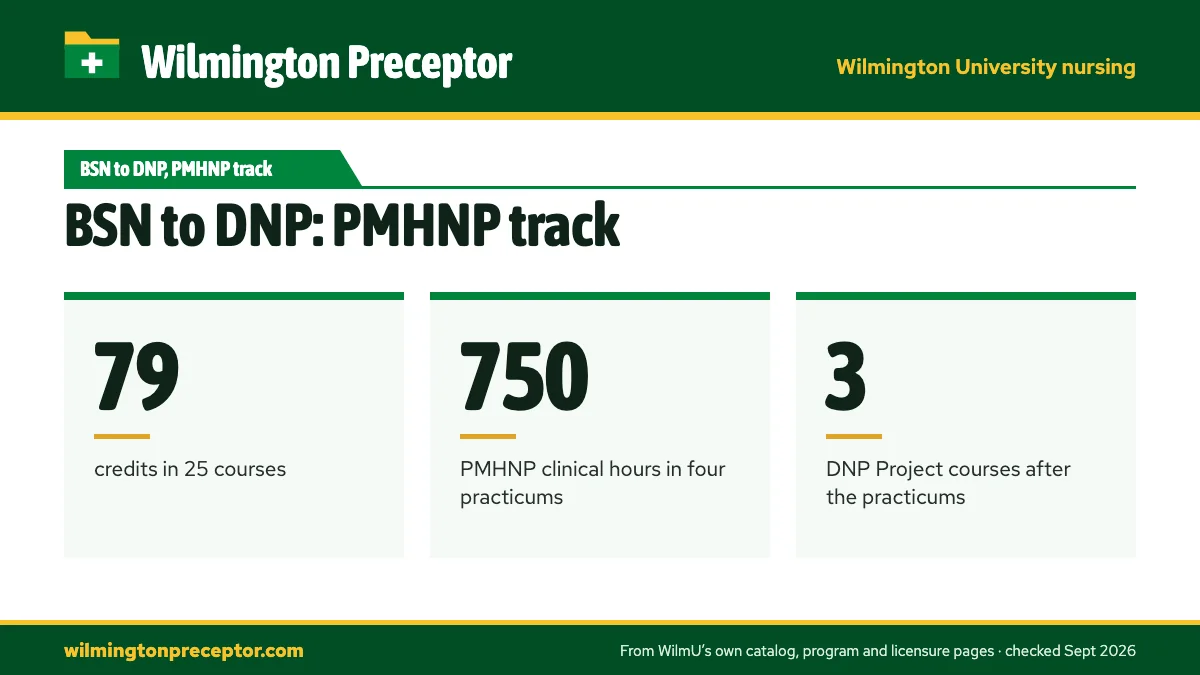
For a nurse with a bachelor's degree, this Psychiatric Mental Health Nurse Practitioner track is the route WilmU offers into the PMHNP role. It runs 79 credits in 25 online courses over about 3.5 years: psychiatric coursework and four PMHNP practicums worth 750 hours, then DNP practice hours and the DNP Project. Below is how the stages connect and where preceptors come in.
Get your placement plan
Tell us your WilmU program and where you live. A placement advisor replies with the preceptor and site options that fit your WilmU course.
Why this track matters at WilmU
WilmU has no MSN in psychiatric mental health. A nurse with a master's or doctorate in hand can add the role through the PMHNP Graduate Certificate, but a BSN-prepared nurse reaches it through this doctoral track. Cohorts start in Fall and Spring, delivery is online, and applicants clear the entry standards of the NP side and the DNP side alike.
At 79 credits and 25 courses, the PMHNP track runs four credits and one course beyond its family practice counterpart, and both are planned across roughly three and a half years. A year-by-year plan is not posted for either, so the order of your terms comes from your advisors and your course plan in MyWilmU Degree Works.
The practical takeaway: you face two separate preceptor searches, one for four psychiatric practicums and one for the doctoral project, with the DNP core courses in between.
The psychiatric phase, course by course
The first part of the track follows the PMHNP course set. The opening two psychiatric courses, GRN 7201 and GRN 7202, come before any clinical work. From Practicum I onward, each clinical course runs alongside a paired didactic course, so what you read about that term is what you see in clinic.
| Paired didactic course | Practicum | Hours |
|---|---|---|
GRN 7203 | GRN 7221 Psychiatric Mental Health Practicum I | 175 |
GRN 7204 | GRN 7222 Practicum II | 175 |
GRN 7205 | GRN 7223 Practicum III | 175 |
| None listed | GRN 7224 Practicum IV | 225 |
The catalog lists the PMHNP course set first, then the DNP core and the project courses. It is silent on whether the psychiatric practicums use seven-week or fifteen-week terms, which decides how many hours per week a preceptor would host you, so get that answer from the PMHNP Assistant Chair. The PMHNP practicums page details each clinical course.
Preceptors for the psychiatric practicums
The Delaware Board of Nursing sets the working standard for APRN program preceptors: an APRN, physician, PA or pharmacist license that is active, unencumbered and comparable in practice focus, with faculty approval and an introduction to the curriculum and to each course's goals. For psychiatric practicums, that points to PMHNPs and psychiatrists above all.
Because each practicum rides alongside a didactic course, a preceptor whose caseload reflects that term's content makes the pairing pay off. BSN-entry students also arrive at GRN 7221 without an earlier NP rotation behind them, so a teaching-minded preceptor for the first practicum is worth extra effort.
Whichever way your placement unfolds, with faculty support or with a search you open yourself, our PMHNP preceptor search guide explains which psychiatric settings suit each stage of the sequence.
From psychiatric practicum to DNP Project
After GRN 7224, the track turns doctoral. The DNP core runs in 7-week blocks, and the project follows across GRN 9001 to GRN 9003 with continuous enrollment. Project I fills a 15-week semester, while Projects II and III each run in seven weeks, at about 145, 145 and 150 hours.
For the doctoral stage, WilmU's curriculum page describes close work with an experiential engagement preceptor holding a doctorate, and it names the student's own workplace as the most common project home. For a PMHNP-track student, a behavioral health setting is a natural fit. Because the Human Subjects Committee reviews your plan during GRN 9001, a project that touches patient information deserves an early conversation with your DNP Project Advisor.
The page on DNP preceptor requirements explains the doctoral preceptor role in more depth.
Counting the hours
WilmU states 750 PMHNP clinical hours plus DNP practice hours for this track and leaves the grand total unstated. The DNP pages bring their own numbers: the GRN 9003 catalog entry sets 1,000 post-baccalaureate hours as the bar for graduating, while the curriculum page and the overview quote 500 and 1,500 hours for advanced practice nurses.
Rather than adding these up yourself, ask the DNP Program Chair to confirm how your psychiatric practicum hours count toward the doctoral requirement. Keep your own running record of every practicum and project hour too, since WilmU's public pages name no hour-logging system. Our DNP practice hours guide compares the figures in one place, so you can bring a precise question to that conversation.
Rules that shape all 3.5 years
A handful of WilmU rules follow you from the first psychiatric course to the final presentation:
- Clinical clearance. Credentialing clearance, a current CPR card and an RN license in each clinical site's state come before
GRN 7221, and completed, up-to-date credentialing is listed again beforeGRN 9001. See clinical credentialing. - Grades. The DNP courses set a B as the passing floor, with one retake allowed per course and a cap of two repeated courses overall.
- Licensure table. The BSN-DNP row, shared with the FNP track, is undetermined in Tennessee, Arizona, Wyoming, New Hampshire, Idaho, North Dakota, Washington, Louisiana and New York. If you live in one of them, ask the Online Learning office.
- Time limit. The DNP pages set a five-year limit, while the undated application packet cites seven. Confirm with the DNP Program Chair which limit governs a BSN entrant.
Why PMHNP-track students choose us
Psychiatric placements take more searching than most, and this track asks for four of them before the doctoral stage begins. We start early. Our search reaches psychiatric nurse practitioners, psychiatrists and other mental health clinicians close to you, only in states where your RN license is valid, pairs each with the course you are taking that term, and screens every license against Delaware's comparable-focus standard.
When the project years arrive, we look for doctorally prepared professionals in behavioral health settings that fit your project idea. Credentials and contact details come organized, health-system steps such as Clinician Nexus intake at ChristianaCare, Bayhealth or Beebe are mapped ahead of time, and a replacement search begins at once if a preceptor withdraws. Decisions on every preceptor and site stay with WilmU faculty, and each file we send them is whole. Reach us through the contact form.
Questions WilmU students ask
Can I become a PMHNP at WilmU with only a BSN?
Yes, through this track. WilmU's program list includes no MSN in psychiatric mental health, so a BSN-prepared nurse reaches the PMHNP role by way of the BSN to DNP PMHNP track. Nurses with an MSN or DNP in hand can choose the PMHNP Graduate Certificate instead. Both routes include the same four psychiatric practicums and 750 clinical hours.
How is the BSN to DNP PMHNP different from the FNP track?
The PMHNP track carries 79 credits in 25 courses against the FNP track's 75 in 24, and its practicums are GRN 7221 to GRN 7224 in psychiatric settings rather than GRN 7121 to GRN 7124 in family practice. Both total 750 NP clinical hours, both span about 3.5 years, and both finish with the same DNP Project courses.
Does the BSN to DNP PMHNP track have an on-campus requirement?
WilmU lists the track as online, and its DNP pages describe no residency on campus, two optional live sessions in each course, and a final presentation you may give online or in person. An undated application packet mentions a hybrid cohort meeting on weekends at the Brandywine site, so ask which format your cohort follows before you plan any travel.
When should I start planning for a psychiatric preceptor?
Earlier than feels necessary. WilmU does not publish placement lead times, but Practicum I comes after the first two PMHNP didactic courses and runs with GRN 7203, so the term is visible in your Degree Works plan long before it arrives. Opening the conversation with faculty and with us a term or two ahead leaves room for health-system onboarding.
Does the licensure table list the PMHNP track separately?
No. WilmU's State Licensures by Program table shows one BSN-DNP row for both BSN to DNP tracks. The post-master's PMHNP certificate has its own PM-PMHNP row, which is undetermined in seven states, while the BSN-DNP row is undetermined in nine, including Arizona and Washington. The table concerns licensure after graduation, not clinical locations.
Related pages
Last checked 2026-09-27
We check these pages against Wilmington University's own program and curriculum pages, the 2026-27 graduate catalog, the College of Nursing and Health Sciences policies and the State Licensures by Program page. Your NP Program Chair, your course faculty and the College have the final word.
A WilmU practicum coming up? Your preceptor search starts here.
Tell us your WilmU program, where you live and when your next practicum starts. Whether WilmU's faculty help with your placement or you are starting the search yourself, we find preceptors who fit the course, check the health system's own intake steps, and organize the preceptor's license and credentials well before the first day.
- Preceptors matched to the course: family practice across the lifespan for
GRN 7121toGRN 7124, psychiatric mental health forGRN 7221toGRN 7224, doctorally prepared for the DNP - Clinicians who meet Delaware's rule for APRN program preceptors: an active APRN, PA, pharmacist or physician license in a comparable focus
- Close to home, in a state where you hold an RN license, with each system's onboarding mapped out early
Start your placement plan
Program, city and semester is all we need to begin.