The doctorally prepared preceptor in Wilmington University's DNP
In Wilmington University's DNP, practice hours are spent with a preceptor who holds a doctorate, whether you are in the Advanced Practice or the Leadership concentration. That preceptor supports the hours and the DNP Project, which WilmU says usually takes place where the student already works, and the Human Subjects Committee signs off on the project plan during GRN 9001.
Get your placement plan
Tell us your WilmU program and where you live. A placement advisor replies with the preceptor and site options that fit your WilmU course.
What WilmU says about the DNP preceptor
WilmU's DNP curriculum page names the role as "a doctorally-prepared experiential engagement preceptor," a statement that covers both concentrations. The catalog uses the same title in GRN 8121 through GRN 8124, the Leadership concentration's experiential engagement sequence, and adds that the student defines the practicum's content in consultation with DNP faculty.
What WilmU leaves unsaid matters as much. Its public pages do not list which doctorates qualify, whether the preceptor has to be a nurse, or how the preceptor is approved. Those questions go to the DNP Program Chair, whose full title also covers directing WilmU's advanced clinical programs, or to the program handbook.
The DNP Project Advisor is a separate role. WilmU assigns one to each student for the project itself, so a DNP student works with a project advisor and with a preceptor in practice, and it pays to know which of the two answers which question.
The courses a DNP preceptor supports
Two groups of courses carry DNP practice hours. The Leadership concentration starts with four experiential engagement courses; both concentrations then move through three DNP Project courses, with continuous enrollment required from GRN 9001 to GRN 9003.
| Course | Who takes it | Hours | Format |
|---|---|---|---|
GRN 8121 to GRN 8124 Experiential Engagement I-IV | Leadership concentration | 125 each | 15-week semesters, one at a time |
GRN 9001 DNP Project I | Both concentrations | About 145 | 15-week semester |
GRN 9002 DNP Project II | Both concentrations | About 145 | 7-week block |
GRN 9003 DNP Project III | Both concentrations | About 150 | 7-week block |
According to their catalog entries, neither GRN 8121 nor GRN 9001 can begin without credentialing that is complete and current, so clearance comes before a preceptor's first supervised hour. The DNP project courses and experiential engagement pages go course by course.
Hours: 500, 1,000 and the overview's 1,500
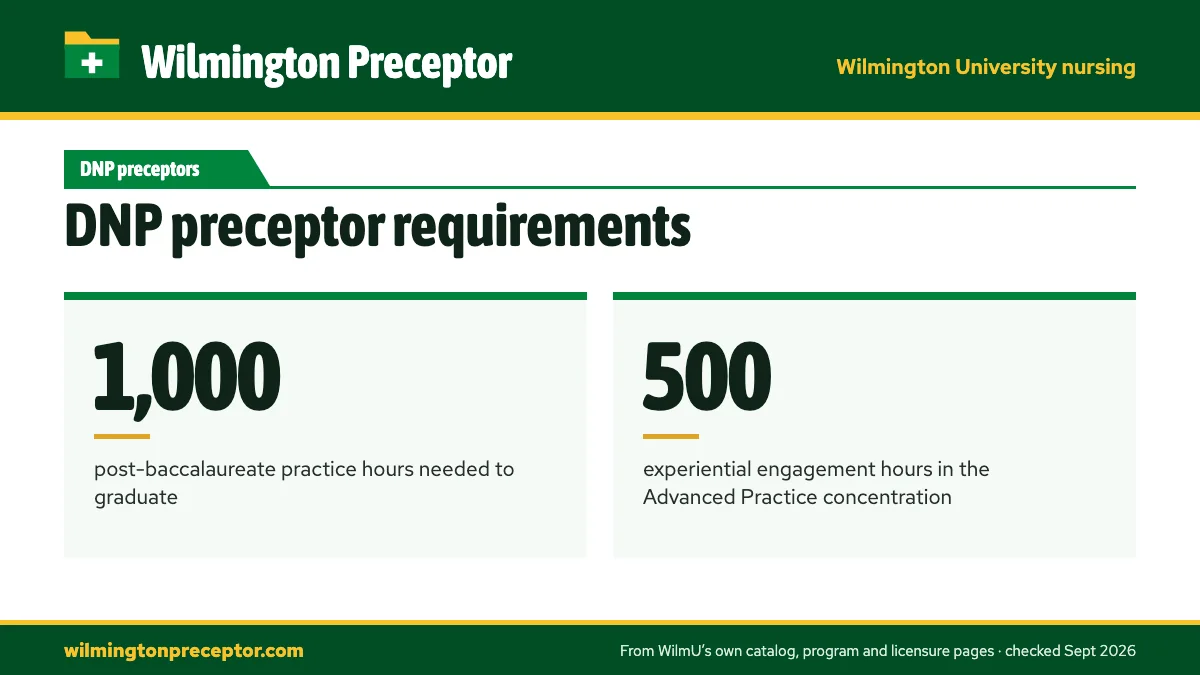
WilmU's DNP curriculum page, admission page and catalog give the Advanced Practice concentration 500 experiential engagement hours within 33 credits, and the Leadership concentration 1,000 practice experience hours within 45 credits. The DNP overview page puts the figure for advanced practice nurses at 1,500, which conflicts with the other three sources; the DNP Program Chair is the person to settle it for your plan.
Behind both figures sits the graduation rule: to finish, a DNP student needs 1,000 practice hours earned after the baccalaureate, along with the completed DNP Project and its presentation. Hours from earlier graduate practicums or clinical courses may count toward the Leadership total, and the Ph.D./DNSc to DNP option credits 500 hours to APRNs who hold board certification. How your prior hours are counted decides how many a preceptor will supervise; the DNP practice hours page lays out each case.
Workplace projects and the preceptor question
Because WilmU describes the typical DNP Project as one carried out inside the student's own workplace, that workplace is the natural first place to look for a doctorally prepared preceptor. It also raises questions the public pages leave open: whether your supervisor or a colleague in your reporting line may serve, and what your organization will want before a student project runs inside it.
Settle the first question with the DNP Program Chair before you ask anyone. If the answer allows a workplace preceptor, look for a doctorally prepared colleague whose role touches the problem your project addresses, since that person will follow the work from GRN 9001 to GRN 9003. If it does not, the search moves to organizations where your project topic already has a home.
Either way, the Human Subjects Committee at Wilmington University still has to approve your project plan in GRN 9001, and the preceptor should know that timeline from the start.
Ask whether your supervisor may serve as preceptor before you ask your supervisor.
Advanced Practice, Leadership and BSN to DNP compared
The doctoral-preparation rule is the same across concentrations, but the road to the project differs. Advanced Practice students enter with a master's degree, an APRN license and a current national board certification as an APRN, and their practice hours sit in GRN 9001 to GRN 9003. Leadership students work through the four experiential engagement courses first, and MSN 7710 covers any gap in advanced pathophysiology, pharmacology or physical assessment.
BSN to DNP students reach the project courses only after the FNP or PMHNP practicums, where the preceptor search follows the NP rules in FNP preceptors and PMHNP preceptors. WilmU's doctoral-preparation statement appears on the DNP curriculum page, so BSN to DNP students should confirm how it applies to their own project courses. WilmU's DNP Program Director and NP Program Chair advise combined and BSN to DNP students together, which makes them the right pair to ask.
How we find doctorally prepared preceptors for WilmU students
A DNP search runs on different lines from an NP search, and we treat it that way. We search among doctorally prepared clinicians and leaders whose work fits your project question, inside your own organization where the program allows it and outside it where it does not, and we confirm each candidate's doctorate, license and role before you hear a name.
You receive a preceptor profile ready for your DNP faculty to review, timed with the Human Subjects Committee step in GRN 9001 in mind, and a placement desk on call through GRN 9003 if anything changes. Every preceptor decision belongs to faculty; our part is making the file complete. Tell us your concentration and start term.
Questions WilmU students ask
Does my WilmU DNP preceptor need a DNP degree?
WilmU's pages say doctorally prepared, not DNP-prepared, and they do not list which doctorates qualify. Whether a PhD-prepared nurse, a physician or a leader with another doctorate fits your concentration is for the DNP Program Chair to answer. Ask before approaching anyone, and keep the answer in writing with your practicum records.
Is the DNP Project Advisor the same person as my preceptor?
WilmU describes them separately. Each DNP student gets an assigned DNP Project Advisor for the project, while the practice hours happen alongside a doctorally prepared preceptor. WilmU's public pages do not describe how the two roles divide the work, so raise it with the DNP Program Chair or look for it in the handbook.
Is there an on-campus residency in WilmU's DNP?
WilmU's DNP pages describe a 100% online program without an on-campus residency, with two optional synchronous sessions per course, and students may present the final project online or in person on campus. WilmU's undated DNP application packet, however, mentions a weekend-intensive hybrid cohort at Brandywine, so confirm the current format with the DNP Program Chair.
What grade do WilmU DNP courses require?
Every DNP course needs at least a B. Below that, you get one retake of the course, and the program caps repeats at two courses in total, tighter than WilmU's general graduate rule. Because the project courses also require continuous enrollment, keeping a preceptor in place through each one matters; see grades and progression.
How long does WilmU's DNP take?
Three figures circulate: 25 months over six part-time semesters on the curriculum page, 28 months per the overview, and a 20-to-28-month range in the undated application packet. The curriculum page also sets a five-year limit, while the packet mentions seven. Before you schedule preceptor hours, check with the DNP Program Chair which figures govern your cohort.
Related pages
Last checked 2026-09-27
We check these pages against Wilmington University's own program and curriculum pages, the 2026-27 graduate catalog, the College of Nursing and Health Sciences policies and the State Licensures by Program page. Your NP Program Chair, your course faculty and the College have the final word.
A WilmU practicum coming up? Your preceptor search starts here.
Tell us your WilmU program, where you live and when your next practicum starts. Whether WilmU's faculty help with your placement or you are starting the search yourself, we find preceptors who fit the course, check the health system's own intake steps, and organize the preceptor's license and credentials well before the first day.
- Preceptors matched to the course: family practice across the lifespan for
GRN 7121toGRN 7124, psychiatric mental health forGRN 7221toGRN 7224, doctorally prepared for the DNP - Clinicians who meet Delaware's rule for APRN program preceptors: an active APRN, PA, pharmacist or physician license in a comparable focus
- Close to home, in a state where you hold an RN license, with each system's onboarding mapped out early
Start your placement plan
Program, city and semester is all we need to begin.