GRN 8121 to GRN 8124: the Leadership concentration's experiential engagement courses
Wilmington University's DNP Leadership concentration contains four experiential engagement courses numbered GRN 8121 through GRN 8124, each carrying 3 credits and 125 hours, or 500 hours in total. You take them singly, each filling a 15-week semester, alongside a preceptor who holds a doctorate, and the catalog leaves the practicum content for you to shape with DNP faculty. Here is how the four courses fit your timeline and what to pin down before the first begins.
Get your placement plan
Tell us your WilmU program and where you live. A placement advisor replies with the preceptor and site options that fit your WilmU course.
The four courses at a glance
| Course | Title | Credits | Hours | Format |
|---|---|---|---|---|
| GRN 8121 | DNP Experiential Engagement I | 3 | 125 | 15-week semester |
| GRN 8122 | DNP Experiential Engagement II | 3 | 125 | 15-week semester |
| GRN 8123 | DNP Experiential Engagement III | 3 | 125 | 15-week semester |
| GRN 8124 | DNP Experiential Engagement IV | 3 | 125 | 15-week semester |
These courses belong to the Leadership concentration, the 45-credit route carrying 1,000 practice experience hours. Advanced Practice students, who arrive as board-certified APRNs, bypass them and move from the DNP core into the three-course project sequence, GRN 9001 onward, which Leadership students complete as well.
Two other routes pick up the same four courses when a student follows the Leadership path: the combined leadership-certificate and DNP options (Legal Nurse Consultant, Nurse Educator, Nurse Executive, Public Health), at 60 credits and 1,000 hours on that path, and the DNP paired with an MBA in Healthcare Administration, at 66 credits and 1,000 hours.
One course per semester: what that does to your timeline
WilmU's DNP curriculum page has you take the experiential engagement courses singly, each across a full 15-week semester, while the core coursework moves in 7-week blocks. Four courses taken singly means at least four 15-week semesters of experiential work. WilmU's year holds three such semesters, fall, spring and summer, so the run spans more than a calendar year even with no break.
Spread evenly, 125 hours over 15 weeks comes to a little over 8 hours a week. That sounds light, yet it is easy to fall behind if the preceptor's calendar tightens in the weeks you planned to use. Map your hours against the semester dates on the academic calendar page before the course opens.
A grade under B in any DNP course means a retake, and each course can be retaken just once. Repeating a 15-week experiential course costs a whole semester, so a stable preceptor matters more here than almost anywhere else in the program.
Practicum content you define with DNP faculty
The GRN 8121 catalog entry hands the definition of the practicum content to you, working in consultation with DNP faculty. That is a statement about what the hours cover, and it puts real planning work on your side of the table before each course.
Arrive with a short outline: the leadership problem or setting you want to work in, what you expect to do during the 125 hours, and why it builds toward your doctoral work. A clear outline makes it easier for faculty to shape the content and for a prospective preceptor to see whether their organization can support it.
Most DNP Projects, WilmU notes, are carried out where the student already works. Whether your experiential hours should build toward that project topic, or deliberately take you somewhere new, is a good early question for DNP faculty and your DNP Project Advisor in GRN 8121.
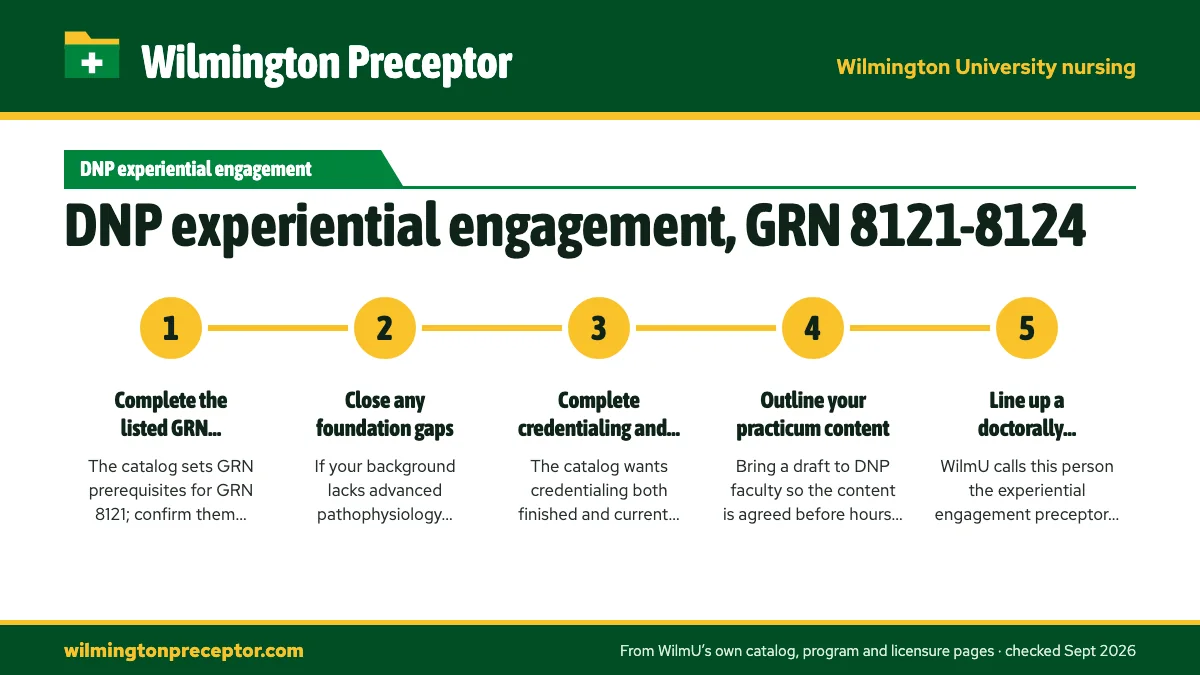
What to have ready before GRN 8121
- Complete the listed GRN coursesThe catalog sets GRN prerequisites for
GRN 8121; confirm them against your plan in MyWilmU Degree Works. - Close any foundation gapsIf your background lacks advanced pathophysiology, pharmacology or physical assessment,
MSN 7710fills that gap for Leadership students. - Complete credentialing and keep it currentThe catalog wants credentialing both finished and current before
GRN 8121. Our clinical credentialing guide covers WilmU's clearance steps; ask what needs renewing across four semesters. - Outline your practicum contentBring a draft to DNP faculty so the content is agreed before hours begin.
- Line up a doctorally prepared preceptorWilmU calls this person the experiential engagement preceptor and asks for doctoral preparation. See our DNP preceptor requirements guide for everything WilmU publishes on the role.
Hours you already have, and the 1,000-hour total
WilmU's DNP curriculum page leaves room to credit practicum or clinical hours you logged in earlier graduate study toward the Leadership concentration. How that credit is documented, and whether it trims what you complete across the four experiential courses, is not spelled out, so ask before you plan four semesters around a full 500.
The totals deserve a second look as well. The four courses here supply 500 hours, and the three project courses are listed at approximately 145, 145 and 150. Put together that is about 940, some 60 short of the concentration's 1,000, and graduation calls for 1,000 practice hours earned after the baccalaureate. The DNP practice hours guide sets every DNP hour figure WilmU publishes side by side.
Questions for the DNP Program Chair
- Which GRN courses must be complete before
GRN 8121on my plan? - Can one preceptor stay with me across all four courses, or should the setting change?
- Can my experiential engagement take place at my own employer?
- How are earlier graduate practicum hours credited, and do they change my experiential hours?
- How do I record and verify my 125 hours each semester?
- Which parts of credentialing need renewing between courses?
WilmU's public pages leave these open, and the answers shape your preceptor search. Put them in writing through your MyWilmU student email so the reply stays on record. The chair's full title also covers advanced clinical programs, and alongside the chair, each DNP student is given a Project Advisor for the project itself.
How we support Leadership DNP students
Whether WilmU faculty are part of your placement or you have already begun reaching out to organizations, we find doctorally prepared preceptors in the leadership settings your practicum content calls for. We can look for one preceptor able to stay with you across all four courses, or a fresh fit each semester if faculty want you to broaden your experience.
Each preceptor's doctoral credential, role and contact details are organized before the semester opens, ready for DNP faculty to review. Approval sits with WilmU faculty, and we send them a file that answers their questions in advance. If a preceptor steps back mid-semester, we are still on the case and bring in someone new. Start with the contact form and tell us which course is next.
Questions WilmU students ask
Do WilmU DNP Advanced Practice students take GRN 8121?
No. The four experiential engagement courses belong to the Leadership concentration. Advanced Practice students, who enter as board-certified APRNs, have their 500 experiential engagement hours tied to the three DNP Project courses beginning with GRN 9001, which Leadership students complete too.
What are the hours and credits for GRN 8121 to GRN 8124?
The 2026-27 graduate catalog gives each of the four courses 125 hours and 3 credits. Together that makes 500 hours, half of the Leadership concentration's 1,000 practice experience hours. Each course runs in a 15-week semester, so the four together take at least four semesters.
Can I take two experiential engagement courses at once at WilmU?
WilmU's DNP curriculum page describes these courses as taken singly, each in its own 15-week semester. If your plan in MyWilmU Degree Works shows something different, or you hope to move faster, ask the DNP Program Chair before registering for the next course in the sequence.
Is WilmU's DNP Leadership concentration online?
WilmU's DNP pages call the program fully online, with nothing that requires time on campus and two optional live sessions offered in each course. A DNP application packet with no date on it tells a different story, a hybrid weekend-intensive cohort based at Brandywine. If the difference affects your plans, ask the DNP Program Chair which format your cohort follows.
Related pages
Last checked 2026-09-27
We check these pages against Wilmington University's own program and curriculum pages, the 2026-27 graduate catalog, the College of Nursing and Health Sciences policies and the State Licensures by Program page. Your NP Program Chair, your course faculty and the College have the final word.
A WilmU practicum coming up? Your preceptor search starts here.
Tell us your WilmU program, where you live and when your next practicum starts. Whether WilmU's faculty help with your placement or you are starting the search yourself, we find preceptors who fit the course, check the health system's own intake steps, and organize the preceptor's license and credentials well before the first day.
- Preceptors matched to the course: family practice across the lifespan for
GRN 7121toGRN 7124, psychiatric mental health forGRN 7221toGRN 7224, doctorally prepared for the DNP - Clinicians who meet Delaware's rule for APRN program preceptors: an active APRN, PA, pharmacist or physician license in a comparable focus
- Close to home, in a state where you hold an RN license, with each system's onboarding mapped out early
Start your placement plan
Program, city and semester is all we need to begin.