GRN 9001 to GRN 9003: WilmU's DNP Project courses
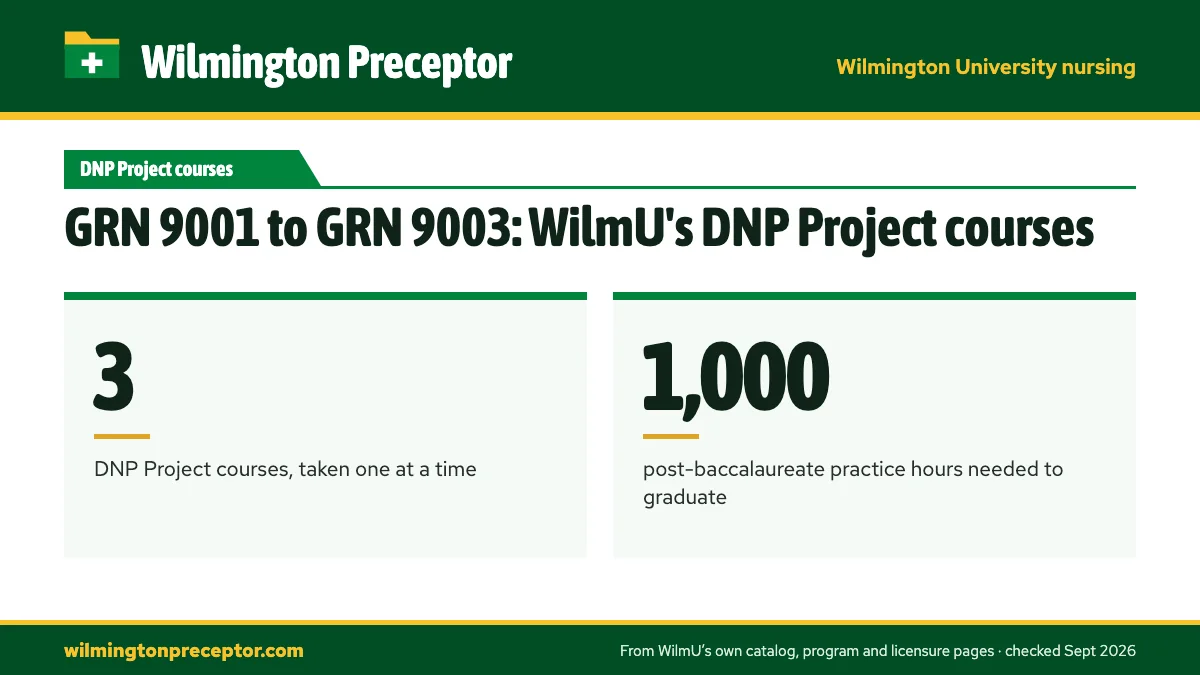
Outside Nurse Anesthesiology, every Wilmington University DNP route closes with three DNP Project courses: GRN 9001 at about 145 hours, GRN 9002 at about 145 and GRN 9003 at about 150. GRN 9001 fills a 15-week semester and is where the Human Subjects Committee reviews your project plan. The next two move to 7-week blocks, taken singly, and your enrollment has to stay unbroken from the first project course to the last.
Get your placement plan
Tell us your WilmU program and where you live. A placement advisor replies with the preceptor and site options that fit your WilmU course.
The three courses and what each carries
| Course | Title | Hours listed | Format and milestone |
|---|---|---|---|
| GRN 9001 | Doctor of Nursing Practice Project I | About 145 | 15-week semester; project plan goes to the Human Subjects Committee |
| GRN 9002 | Doctor of Nursing Practice Project II | About 145 | 7-week block |
| GRN 9003 | Doctor of Nursing Practice Project III | About 150 | 7-week block; its entry states the graduation rule |
This project sequence runs through both DNP concentrations, both BSN to DNP tracks once their NP practicums are done, the combined certificate options and the MBA in Healthcare Administration pairing. Doctorally prepared nurses entering through the Ph.D./DNSc option finish with project coursework as well. Leadership students also complete four experiential engagement courses of 125 hours each.
Continuous enrollment and the change of pace
Enrollment has to stay unbroken across all three project courses, and you take them singly. After the 15-week opener, the remaining two shrink to 7-week blocks, and that shift changes the weekly load more than the hour totals suggest.
| Course | Hours listed | Weeks | Per week |
|---|---|---|---|
| GRN 9001 | About 145 | 15 | About 10 |
| GRN 9002 | About 145 | 7 | About 21 |
| GRN 9003 | About 150 | 7 | About 21 |
Put simply, your weekly project time roughly doubles once GRN 9001 ends. The calendar leaves little slack between courses: on the 2026-27 calendar, the 15-week Spring 2027 semester ends May 2 and Summer 2027 Block 1 begins May 10. Check your own sequence in MyWilmU Degree Works and on the academic calendar page, and warn your preceptor about the heavier block weeks well ahead.
GRN 9001 and the Human Subjects Committee
Approval of your project plan by the Wilmington University Human Subjects Committee happens inside GRN 9001. The catalog also names credentialing, finished and kept current, among the course's prerequisites, so clinical credentialing clearance has to be in order before the semester starts, not partway through it.
According to WilmU's DNP pages, the student's own workplace is the most common home for the project. If that is true for you, ask your employer early whether the organization has its own review or sign-off for a project of this kind, because any such step runs on its own clock alongside the committee's.
The catalog does not say which project activities, or which hours, can begin before the committee approves your plan. Ask your DNP Project Advisor at the start of GRN 9001. The answer tells you how many of the course's roughly 145 hours are realistic in the first weeks and how many will fall after approval.
The people around your project
Several WilmU roles touch the project courses, and keeping them straight saves time. The who does what guide lists every practicum role by title.
- Your DNP Project Advisor, assigned to each student, guides the project itself.
- The Human Subjects Committee reviews and signs off on your plan during the first project course.
- A preceptor with a doctorate, whom WilmU calls the experiential engagement preceptor, works with you at the practice site.
- DNP faculty teach the courses and help you shape the practicum content.
- The DNP Program Chair handles program-level questions such as hours and sequence.
WilmU's public pages say nothing on whether your preceptor may be a colleague or supervisor at your workplace. If no one at your organization holds a doctorate, ask DNP faculty how an outside preceptor works when the project sits at your job. Our DNP preceptor requirements page gathers what WilmU publishes on the role.
Grades, repeats and finishing on time
Nothing below a B passes in a DNP course, and the project courses are no exception. You get one retake of any course that falls short, and the program as a whole allows two repeated courses at most. Since enrollment must stay unbroken through the project phase, ask how a retake of GRN 9001 or GRN 9002 would slot into the sequence before you ever need to know.
An Incomplete requires the instructor's approval in advance. The deadline is whatever the instructor sets, capped at 60 days past the course's end, after which the I converts to an F. You have five years to finish according to the curriculum page, while the undated application packet mentions a seven-year window. Our incompletes, withdrawal and time limits page covers both.
To graduate you need the project, its presentation and 1,000 practice hours earned after your baccalaureate. The three course entries add up to roughly 440 hours, well short of 1,000, so the balance has to come from hours counted elsewhere in your route. Our DNP practice hours guide works through that arithmetic.
How we help with the project phase
Whoever starts the search, WilmU faculty or you, we find doctorally prepared preceptors who fit your project setting, inside your workplace or beyond it. We time the search so the preceptor is confirmed before GRN 9001 opens, and we check that they can handle the heavier weekly hours of the two 7-week blocks.
The preceptor's doctoral credential, position and contact details come organized for DNP faculty review. Faculty make the call on each preceptor and site, and the paperwork we prepare is meant to let them decide without chasing anything. If a preceptor leaves partway through the project, we remain on hand and arrange a successor so unbroken enrollment stays safe. Tell us your first project term through the contact form.
Questions WilmU students ask
What happens in GRN 9001 at WilmU?
GRN 9001 Doctor of Nursing Practice Project I opens the project sequence. It fills a 15-week semester, lists about 145 hours, and is the course in which the Wilmington University Human Subjects Committee considers your project plan. Credentialing that is complete and current is a prerequisite.
Can I take a break between WilmU DNP Project courses?
WilmU requires unbroken enrollment through GRN 9001, GRN 9002 and GRN 9003, and no leave-of-absence rule appears in the public graduate catalog. If illness, work or family forces a pause, speak with the DNP Program Chair and your DNP Project Advisor before the next course starts rather than after.
Do BSN to DNP students take GRN 9001 to GRN 9003?
Yes. Both BSN to DNP tracks list the FNP or PMHNP course set first, including the four practicums, then the DNP core and the three project courses. Students on these tracks have two advisors working together, the NP Program Chair and the DNP Program Director, so bring sequence questions to both.
Where do WilmU DNP students present the final project?
The DNP curriculum page lets you present the finished project either online or in person on campus, and the program sets no on-campus residency. The presentation belongs to the graduation requirement stated in the GRN 9003 entry, along with the 1,000 practice hours.
Does the DNP Project have to be at my workplace?
WilmU's DNP pages describe the workplace as the usual home for the project, which is a description of the common pattern rather than a rule. If your workplace is not a good fit, raise it with your DNP Project Advisor early, since the setting shapes both the project plan and the preceptor.
Related pages
Last checked 2026-09-27
We check these pages against Wilmington University's own program and curriculum pages, the 2026-27 graduate catalog, the College of Nursing and Health Sciences policies and the State Licensures by Program page. Your NP Program Chair, your course faculty and the College have the final word.
A WilmU practicum coming up? Your preceptor search starts here.
Tell us your WilmU program, where you live and when your next practicum starts. Whether WilmU's faculty help with your placement or you are starting the search yourself, we find preceptors who fit the course, check the health system's own intake steps, and organize the preceptor's license and credentials well before the first day.
- Preceptors matched to the course: family practice across the lifespan for
GRN 7121toGRN 7124, psychiatric mental health forGRN 7221toGRN 7224, doctorally prepared for the DNP - Clinicians who meet Delaware's rule for APRN program preceptors: an active APRN, PA, pharmacist or physician license in a comparable focus
- Close to home, in a state where you hold an RN license, with each system's onboarding mapped out early
Start your placement plan
Program, city and semester is all we need to begin.