WilmU's DNP Advanced Practice concentration for board-certified APRNs
Wilmington University's Advanced Practice concentration is the shorter DNP route: 33 credits for nurses who come in with a master's degree and are currently board certified as APRNs at the national level. Its practice hours sit inside three DNP Project courses rather than separate practicums, and each of those courses is completed beside a preceptor holding a doctorate. We find that person for APRNs whose clinics and schedules leave little room for the search.
Get your placement plan
Tell us your WilmU program and where you live. A placement advisor replies with the preceptor and site options that fit your WilmU course.
Who the concentration is designed for
WilmU's DNP curriculum page sets two entry conditions for Advanced Practice: a completed master's degree and national APRN board certification that is still current. The DNP admission page frames the same requirement in licensing terms, asking applicants for an APRN license together with that national certification.
That places this concentration apart from WilmU's nurse practitioner programs. You arrive already certified in an advanced role, so there are no population-focused practicums to repeat. The concentration adds the doctoral core and the DNP Project on top of the clinical expertise you bring, and the project is where your practice hours happen.
Start terms, deadlines and delivery are shared with the Leadership concentration and summarized on the DNP overview. In short: three starts a year, online coursework and no on-campus residency.
Where the 500 hours sit
Advanced Practice skips the four experiential engagement courses, which belong to the Leadership concentration alone. Its practice hours run through the project sequence, one course at a time, with continuous enrollment required from the first project course to the last.
| Course | Approximate hours | Format | What the catalog adds |
|---|---|---|---|
GRN 9001 Doctor of Nursing Practice Project I | About 145 | 15-week semester | Project plan goes to the Human Subjects Committee; credentialing complete and current first |
GRN 9002 Doctor of Nursing Practice Project II | About 145 | 7-week block | Taken after GRN 9001, one course at a time |
GRN 9003 Doctor of Nursing Practice Project III | About 150 | 7-week block | Graduation check: 1,000 post-baccalaureate hours, the project and its presentation |
The per-course figures are approximate, and how they build to the concentration's total is worth confirming with the DNP Program Chair. The two later courses are 7-week blocks carrying roughly 145 and 150 hours, a heavy pace beside a clinical job, so settle protected time with your preceptor before each block opens. The DNP project courses page walks through each course.
500 hours or 1,500: the published conflict
WilmU's figures for advanced practice nurses disagree. The curriculum page, the DNP admission page and the catalog give 500 practice hours; the DNP overview page gives 1,500. The DNP Program Chair can confirm which figure applies to your cohort, and it is worth keeping that answer in writing.
A second number sits behind both. The catalog's graduation rule for every DNP student is 1,000 post-baccalaureate practice hours. For the Ph.D. or DNSc to DNP route, WilmU states that 500 of those hours are credited to board-certified APRNs. For this concentration, ask how the clinical hours from your master's program are documented toward the 1,000, and which records you should gather to show them.
The DNP practice hours page sets every hour rule side by side, including the Leadership figures.
Choosing a doctorally prepared preceptor as a working APRN
Doctoral preparation is WilmU's requirement for DNP preceptors in either concentration, and the school observes that a student's own employer is the most common setting for the project. For an APRN, the first place to look is your own organization: a doctorally prepared colleague whose expertise overlaps your project topic and who has room to mentor.
Some questions only WilmU can answer. Whether your direct supervisor, a practice partner or a coworker from your unit can serve as your preceptor is one; how the preceptor is confirmed is another. Put both to your DNP Project Advisor before you ask anyone to commit, so the answer is settled before anyone signs on.
If you precept NP students yourself while studying, Delaware's Board rules for APRN program preceptors are explained on the Delaware APRN practice and preceptors page. They are a separate matter from WilmU's doctoral preparation rule for your own DNP preceptor.
Timing your preceptor around GRN 9001
Exact timing is a question for your DNP Project Advisor. WilmU's catalog prerequisites still suggest a sensible order, worked backward from the first project course.
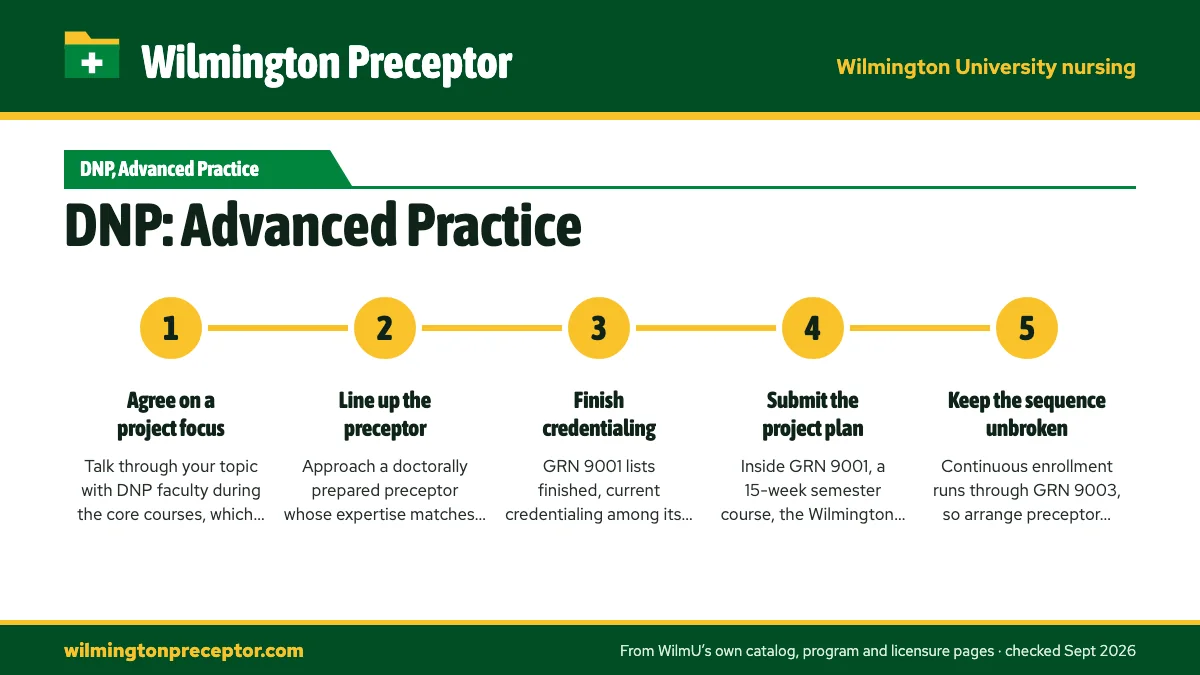
- Agree on a project focusTalk through your topic with DNP faculty during the core courses, which run in 7-week blocks.
- Line up the preceptorApproach a doctorally prepared preceptor whose expertise matches the topic and who can commit across all three project courses.
- Finish credentialing
GRN 9001lists finished, current credentialing among its prerequisites; the clinical credentialing guide explains how WilmU's clearance works. - Submit the project planInside
GRN 9001, a 15-week semester course, the Wilmington University Human Subjects Committee reviews and approves the plan. - Keep the sequence unbrokenContinuous enrollment runs through
GRN 9003, so arrange preceptor coverage for both 7-week blocks that follow.
For reference, WilmU's 2026-27 fifteen-week terms: Fall runs Aug. 31 through Dec. 13, Spring Jan. 11 through May 2 and Summer May 10 through Aug. 23.
What to have ready before the project sequence
Most of what the project courses ask for can be gathered during the core. These items come straight from WilmU's published requirements, plus the preceptor details faculty will want to see.
- Your APRN license and proof of current national APRN board certification, as the admission page lists them.
- Records of the clinical hours from your master's program, so the DNP Program Chair can tell you how they relate to the 1,000-hour graduation rule.
- Clinical credentialing clearance: a background check plus drug screen, completed in the College's designated system at your own expense.
- A short written description of your project topic and setting, which makes the first preceptor conversation far easier.
- Your preceptor's license, doctoral degree, current role and contact details in one place.
Keep copies together in one folder you control, because the same details come up again in each project course.
Why working APRNs hand us the search
Advanced Practice students arrive board certified, and clinical work rarely leaves room for weeks of outreach. Whether WilmU's DNP faculty suggest a name or you are building the list yourself, we handle the legwork: we identify doctorally prepared clinicians and leaders whose expertise fits your project, confirm their interest and availability across three courses, and hand you a complete preceptor file with license, credential and contact details.
Every preceptor and site is WilmU faculty's decision. We make sure the paperwork they open is whole from the start, so any questions are about fit rather than missing documents.
If your preceptor changes jobs or steps back between GRN 9002 and GRN 9003, we move quickly on a replacement, because a gap in continuous enrollment costs more than time. The preceptor dropped out page covers that case, and the form below starts your request.
Questions WilmU students ask
Do I need an APRN license for WilmU's Advanced Practice DNP?
Yes. WilmU's DNP admission page wants an APRN license from Advanced Practice applicants, together with national board certification in an APRN role, and the curriculum page adds a master's degree. WilmU's other route, the Leadership concentration, carries 1,000 practice hours and adds MSN 7710 for students who have not yet covered advanced pathophysiology, pharmacology and physical assessment.
Does the Advanced Practice DNP include GRN 8121 to GRN 8124?
No. WilmU's catalog keeps GRN 8121 through GRN 8124, the experiential engagement quartet, inside the Leadership concentration. Advanced Practice hours instead accrue across the three project courses, one per term: a 15-week semester for the first, then two 7-week blocks.
Can my DNP preceptor work at my own clinic?
Because WilmU names the student's workplace as the usual project setting, a preceptor from your own organization fits the pattern well. Whether a direct supervisor or practice partner can serve is a question for your DNP Project Advisor. Either way, the preceptor has to be doctorally prepared.
How long does the Advanced Practice DNP take?
WilmU's curriculum page gives 25 months part time over 6 semesters, the overview says 28 months, and the undated packet gives a 20-to-28-month range. The time limit is five years on the curriculum page, though the packet FAQ mentions seven. Confirm your own plan with the DNP Program Chair and in MyWilmU Degree Works.
What happens if I earn below a B in a DNP project course?
WilmU requires a B or better in all DNP courses. Earn less than a B and you get one retake of that course; across the whole program, two repeated courses is the ceiling. In the project sequence a retake also shifts your preceptor's schedule, so tell them early. The grades and progression page covers probation and appeals.
Related pages
Last checked 2026-09-27
We check these pages against Wilmington University's own program and curriculum pages, the 2026-27 graduate catalog, the College of Nursing and Health Sciences policies and the State Licensures by Program page. Your NP Program Chair, your course faculty and the College have the final word.
A WilmU practicum coming up? Your preceptor search starts here.
Tell us your WilmU program, where you live and when your next practicum starts. Whether WilmU's faculty help with your placement or you are starting the search yourself, we find preceptors who fit the course, check the health system's own intake steps, and organize the preceptor's license and credentials well before the first day.
- Preceptors matched to the course: family practice across the lifespan for
GRN 7121toGRN 7124, psychiatric mental health forGRN 7221toGRN 7224, doctorally prepared for the DNP - Clinicians who meet Delaware's rule for APRN program preceptors: an active APRN, PA, pharmacist or physician license in a comparable focus
- Close to home, in a state where you hold an RN license, with each system's onboarding mapped out early
Start your placement plan
Program, city and semester is all we need to begin.