Delaware APRN practice, the Board's preceptor rules and the 2027 grant law
Delaware grants full practice and prescriptive authority with the APRN license itself, with no collaborative agreement and no transition period. The Board of Nursing also decides who may precept in an APRN program and how faculty stay in charge, rules that shape every Wilmington University practicum in the state. From February 20, 2027, a new law adds grants for facilities that host advanced-practice preceptorships.
Get your placement plan
Tell us your WilmU program and where you live. A placement advisor replies with the preceptor and site options that fit your WilmU course.
Full practice from the day the license issues
Under 24 Del. C. §1935, the Board of Nursing grants full practice and prescriptive authority when it issues the APRN license. Nothing stands between licensure and independent practice: no transition-to-practice period and no physician agreement. The collaborative agreement section, §1936, was repealed by 83 Del. Laws c. 111, effective August 4, 2021, and the Board's FAQ confirms that full practice authority comes with the license.
Within role and population focus, a Delaware APRN may prescribe and dispense over-the-counter, legend and controlled drugs, order therapy and services, diagnose and refer, and sign death certificates. The statute pairs that scope with a duty to seek consultation when a patient's needs or the APRN's expertise call for it, and holds APRNs to the standard of care a physician would owe for the same condition.
For a WilmU student, the upshot is the shape of the preceptor pool. With no physician agreement required for independent practice, NP-led clinics sit alongside hospital and physician practices as places a Delaware preceptor may work.
What the Board asks of an APRN program preceptor
Rules 8.16.6 to 8.16.8 of the Board's regulations divide the work between the preceptor and the school's faculty:
- Preceptors add to faculty-directed learning; they do not take its place.
- In the Board's words, "Faculty are not expected to be in the clinical setting with precepted students."
- Faculty approve each preceptor.
- The preceptor's license may be APRN, physician assistant, pharmacist or physician, and it has to be active and unencumbered, with a practice focus comparable to the track the student is in.
- Preceptors supervise, teach and evaluate, while faculty keep responsibility for the evaluation.
- Each preceptor is oriented to the curriculum and the course objectives.
Comparable focus is the test that shapes a WilmU search: lifespan family care matches an FNP student, and psychiatric mental health practice matches a PMHNP student. WilmU's public pages do not list NP preceptor credentials of their own, so the program handbook and your course faculty settle the finer points.
Licensure level, hours and the student's RN license
The Board's general rules add three points. Rule 2.1 defines a preceptor in general terms: a licensed nurse holding at least a BSN who has shown competence in the student's area. Whoever precepts is licensed or privileged no lower than the level the student is training toward, in the state where the precepting happens (rules 2.4.1.5.14 and 2.4.1.5.17). And nursing faculty direct every student clinical experience, precepted ones included.
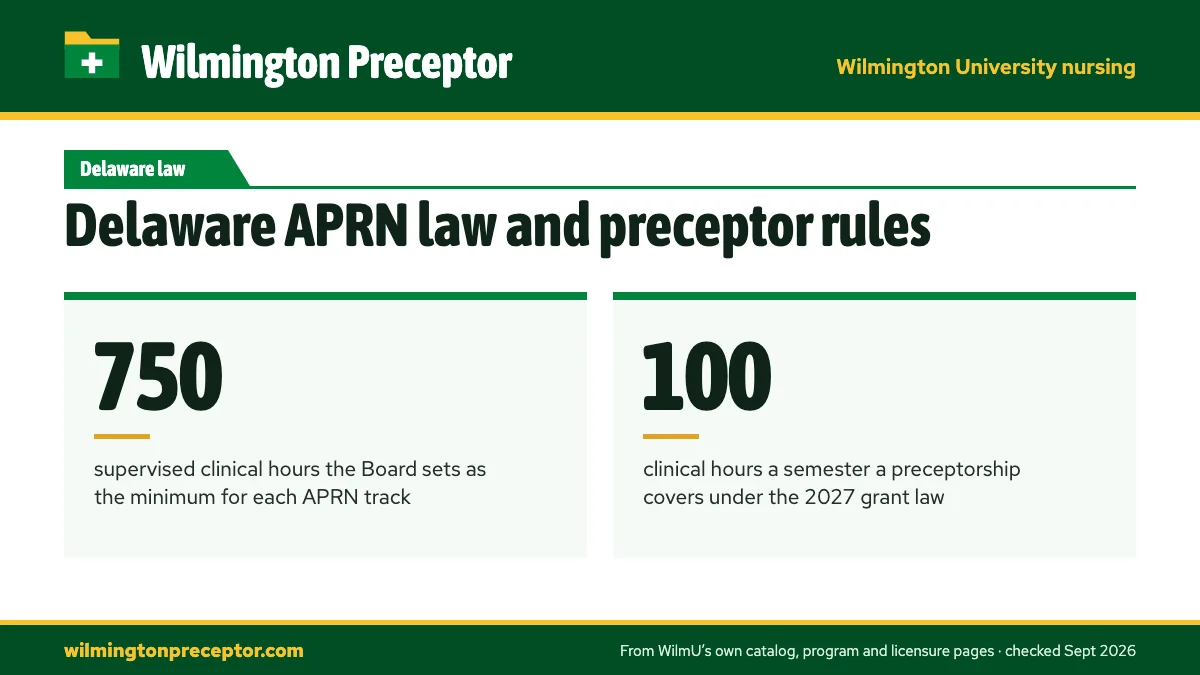
Each APRN track needs at least 750 supervised clinical hours, the same total as the 750 hours in WilmU's FNP and PMHNP tracks. An APRN student's RN license or privilege stays active from before the first clinical course to the end of the last one, and an RN in an APRN program needs no APRN license for program clinicals while a qualified instructor directly supervises. WilmU's own license condition, tied to the state where the clinical happens, has its own guide.
Programs from other states, and a question the rules leave open
Before a program based outside Delaware places students in a Delaware clinical facility, it notifies the Board and files proof of approval or accreditation, signed agreements covering every clinical agency, its preceptor requirements, preceptor names and sites, and copies of every preceptor's current Delaware or multistate license. WilmU is based in New Castle, so this filing belongs to programs from other states.
Nothing in Chapter 19 or the Board rules says whether the school or the student lines up the preceptor. The nearest thing is in the grant law below, which asks funded facilities for a consistent preceptor assignment and structured preceptorship planning.
HB 385: grants for facilities that host preceptorships
House Bill 385 was signed on August 20, 2026 as 85 Del. Laws c. 438 and takes effect February 20, 2027. It adds 16 Del. C. §198, creating grants for hospitals, federally qualified health centers and other clinical facilities that host preceptorships for advanced-practice nursing students completing at least 100 clinical hours a semester, with an APRN, physician assistant, physician or nurse as preceptor.
Three details matter. The law defines a preceptorship as uncompensated, so money goes to the facility rather than the individual preceptor. The Delaware Nurses Workforce Institute or a similar nonprofit runs the program. And funding depends on annual appropriation, so no year's grants are assured.
Delaware has no preceptor tax credit in law: HB 136, a personal income tax credit for nursing preceptors, stalled in House Appropriations in 2023 and died with that General Assembly. The Delaware Nursing Advancement Fund, created by 85 Del. Laws c. 456 and paid for by a license surcharge from January 1, 2027, funds nursing workforce data and studies rather than precepting.
After graduation: the Delaware license path in brief
Delaware enacted the APRN Compact as Chapter 19B, but the chapter takes effect only when a condition in that law is met, and the code still shows it pending. Until then, a new graduate keeps an active RN license, passes national certification and applies in DELPROS within two years of graduating.
A temporary APRN permit can bridge the months before certification: 90 days, extendable in 90-day steps up to two years, with no prescriptive authority. Controlled substances take a Delaware controlled substance registration, with its one-hour course on Delaware prescribing law, and then a DEA registration. The Delaware state guide walks through the full sequence.
How we apply these rules to your search
Each clinician we put forward for a WilmU practicum is checked against rule 8.16: license type, active and unencumbered status, a practice focus that matches your track, and a license that covers the state where you will train. For DNP courses we add WilmU's own condition that the preceptor is doctorally prepared.
Since the Board wants every preceptor oriented to the course's objectives, we brief each one on your WilmU course, its hours and where it falls in the sequence. WilmU's faculty settle each preceptor and site, and our file answers the Board's questions before they need asking. See how it works, or tell us which course you need.
Questions WilmU students ask
Do nurse practitioners in Delaware need a collaborative agreement?
No. Delaware repealed its collaborative agreement section in 2021, and the Board grants full practice and prescriptive authority with the APRN license. New graduates have no transition period to complete, though prescribing controlled substances still takes a Delaware controlled substance registration and a DEA registration for Delaware.
Can a physician assistant or pharmacist precept an NP student in Delaware?
The Board's APRN program rules accept four license types, APRN, physician assistant, pharmacist or physician, provided it is current, carries no encumbrance and sits in a practice focus close to the student's track. Faculty approve each preceptor. WilmU's public pages add no NP preceptor credentials, so confirm the fit for your course with your faculty.
Does Delaware pay clinical preceptors?
Not directly. The 2027 grant law funds facilities that host preceptorships, defines the preceptorship itself as uncompensated, and depends on annual appropriation. Delaware has no preceptor tax credit; the 2023 bill that proposed one stalled in House Appropriations and died when that General Assembly ended.
Has Delaware's APRN Compact taken effect?
Not yet. Delaware enacted it as Chapter 19B in 2021, but the chapter takes effect only when a condition in that law is met, and the Delaware Code still shows it pending. For now, an APRN serving Delaware patients holds a Delaware APRN license with an active Delaware or multistate RN license.
Does an NP student need an APRN license for clinicals in Delaware?
No. Under the Board's rules, an RN enrolled in an APRN program needs no APRN license for program clinicals as long as a qualified instructor directly supervises. What the student does need is an active RN license or privilege before and throughout the APRN clinical courses.
Related pages
Last checked 2026-09-27
We check these pages against Wilmington University's own program and curriculum pages, the 2026-27 graduate catalog, the College of Nursing and Health Sciences policies and the State Licensures by Program page. Your NP Program Chair, your course faculty and the College have the final word.
A WilmU practicum coming up? Your preceptor search starts here.
Tell us your WilmU program, where you live and when your next practicum starts. Whether WilmU's faculty help with your placement or you are starting the search yourself, we find preceptors who fit the course, check the health system's own intake steps, and organize the preceptor's license and credentials well before the first day.
- Preceptors matched to the course: family practice across the lifespan for
GRN 7121toGRN 7124, psychiatric mental health forGRN 7221toGRN 7224, doctorally prepared for the DNP - Clinicians who meet Delaware's rule for APRN program preceptors: an active APRN, PA, pharmacist or physician license in a comparable focus
- Close to home, in a state where you hold an RN license, with each system's onboarding mapped out early
Start your placement plan
Program, city and semester is all we need to begin.