Precepting a Wilmington University nursing student
Wilmington University's nurse practitioner students complete 750 clinical hours across four practicums, and its DNP students work with a doctorally prepared preceptor. If you practice family care, psychiatric mental health or at the doctoral level, this page explains who qualifies under Delaware's rules, what each WilmU course involves and what the student brings to your setting.
Offer to precept
Tell us your license, specialty and where you practice. We reply with WilmU students whose course fits your setting.
Who can precept a WilmU student
Delaware sets the bar through its Board of Nursing. You hold one of four licenses, APRN, physician assistant, pharmacist or physician; it is active and unencumbered; and your practice focus is comparable to the student's track. Your license also has to match or exceed the level the student is working toward, in the state where you precept.
Outside Delaware, the board rules of the state where you practice apply, and WilmU's faculty have the final word on each preceptor for the course. DNP students need a preceptor with a doctorate, a condition WilmU sets itself. In the MSN Leadership Educator concentration, MSN 7752 pairs the student with an approved mentor for 32 clinical hours. The full Delaware rule set is on our APRN law and preceptor rules page.
The WilmU courses you might take on
Each NP practicum is a 4-credit course, and WilmU counts planned simulation within the FNP's 750 hours. A student arriving for GRN 7121 has already finished advanced health assessment in a clinical laboratory setting and a course in differential diagnosis. PMHNP students take each of the first three practicums alongside a paired didactic course, so the clinical work and the classroom topic move together.
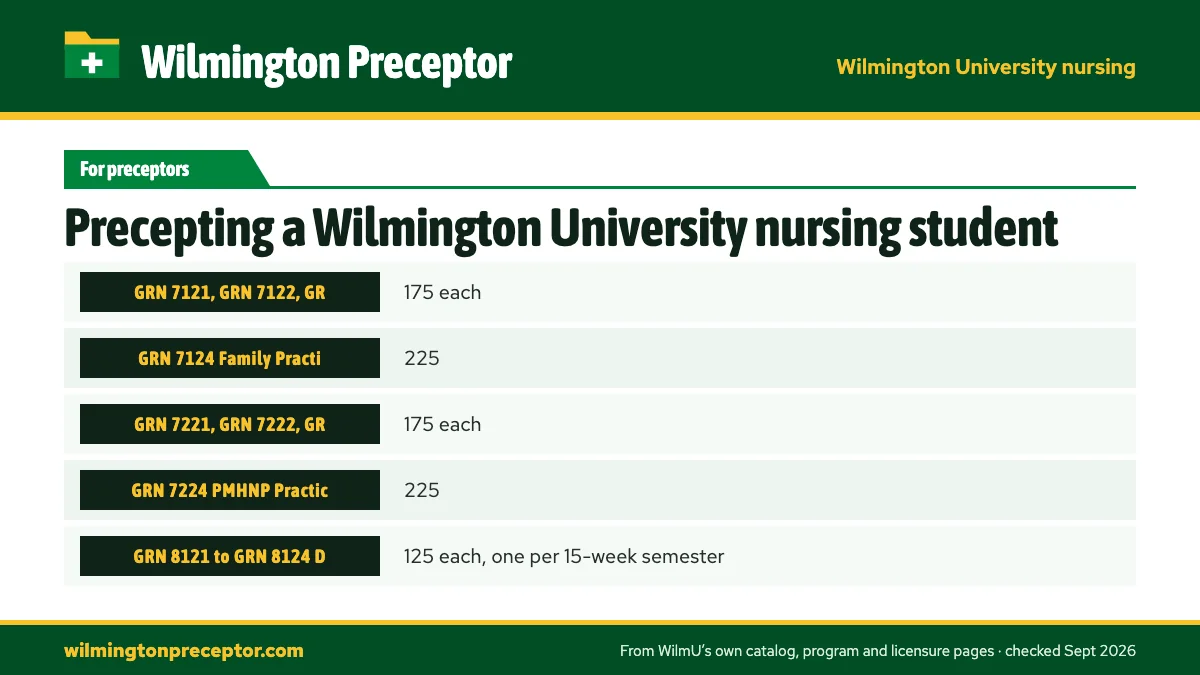
| Course | Hours | Your practice |
|---|---|---|
GRN 7121, GRN 7122, GRN 7123 Family Practicum I to III | 175 each | Family practice, patients of all ages |
GRN 7124 Family Practicum IV | 225 | Family practice, patients of all ages |
GRN 7221, GRN 7222, GRN 7223 PMHNP Practicum I to III | 175 each | Psychiatric mental health |
GRN 7224 PMHNP Practicum IV | 225 | Psychiatric mental health |
GRN 8121 to GRN 8124 DNP Experiential Engagement I to IV | 125 each, one per 15-week semester | Doctorally prepared |
GRN 9001 to GRN 9003 DNP Project I to III | About 145, 145 and 150 | Doctorally prepared |
MSN 7752 Clinical Teaching and Evaluation | 32 | An approved mentor |
The FNP preceptor guide and the DNP preceptor guide go deeper into each track.
What precepting involves
Delaware's rules describe the preceptor's job in three verbs: supervise, teach and evaluate. You guide the student through real patient care in your setting, explain the reasoning behind your decisions and give your view of the student's progress, while WilmU's faculty direct the learning and keep responsibility for the evaluation.
The Board says outright that faculty need not be present in your clinic alongside the student. What its rules ask for instead is orientation, so that each preceptor knows the curriculum and the course objectives. WilmU's course faculty are the people to ask about evaluations, schedules and any site visits, since WilmU's public pages leave those details to the course.
What the student brings
Every WilmU NP student arrives with CPR certification that is current and an RN license valid in the state where your clinic sits. Graduate students also clear a background check and drug screen through the College's designated credentialing system, and WilmU lists clinical credentialing clearance as complete before clinical courses begin.
NP students are covered by group professional liability insurance that the University carries; the CPR and liability insurance guide covers what WilmU says about it. If your organization runs its own onboarding, such as the Clinician Nexus process that ChristianaCare, Bayhealth and Beebe describe, the student completes that as well, and we keep both sets of requirements on one timeline.
Agreements and your organization's own rules
The College's background check policy speaks of "contractual agreements" with clinical facilities, and some systems, ChristianaCare among them, ask for a school affiliation agreement before a student arrives. Whether your practice needs one for a given placement is a question for WilmU's faculty, and we raise it at the very start so it is settled before the first clinical day. The affiliation agreements guide explains the idea.
Your employer's policies on students, scheduling and space come first, and the student fits around them. We share the course, the hours and the target dates up front so you can check capacity with your practice before you say yes.
Delaware's 2027 grant law
HB 385, signed in 2026, opens grants from February 20, 2027 to Delaware facilities, hospitals and federally qualified health centers among them, that take advanced-practice nursing students for preceptorships of 100 or more clinical hours per semester. Under the law's definition the preceptor works unpaid, and the money goes to the host facility. A nonprofit such as the Delaware Nurses Workforce Institute administers it, and each year's funding waits on an appropriation.
If you practice in a Delaware facility, it is worth asking your administrator whether it plans to apply once the program opens. Delaware law has no preceptor tax credit.
How we work with preceptors
Our requests are specific: one student, one WilmU course, the hours it needs and the semester it falls in, so you can decide quickly. Once you agree, we collect your license and credential details once and organize them for WilmU's faculty, whose call it is on each preceptor and site.
We stay in touch through the course. If your schedule shifts, tell us early and we work with you and the student to keep the hours moving, or line up a replacement if needed. Use the form on this page to share your license, focus and location, or read how our placements work.
Questions WilmU students ask
Can a physician or PA precept a WilmU nurse practitioner student?
Yes, in Delaware. The Board lets a physician or physician assistant precept an APRN student when the license is current, carries no restrictions and covers a practice area like the student's track, and pharmacists qualify on the same terms. WilmU's faculty have the final word on each preceptor, and outside Delaware the rules of the state where you practice apply as well.
How many hours would a WilmU student spend with me?
It depends on the course. The first three Family or PMHNP practicums list 175 hours each and the fourth lists 225, with FNP totals counting planned simulation. DNP Experiential Engagement courses list 125 hours each over a 15-week semester, the DNP Project courses about 145 to 150, and MSN 7752 lists 32.
Do I need a doctorate to precept a WilmU DNP student?
Yes. WilmU says DNP students work with a doctorally prepared experiential engagement preceptor, in both the Advanced Practice and Leadership concentrations. Most DNP Projects take place where the student already works, and WilmU's Human Subjects Committee reviews each project plan during GRN 9001.
Is a WilmU student covered by liability insurance?
WilmU states that its NP students are covered by a group professional liability policy the University holds. Your organization may set its own requirements for students on site, so check those with your administrator, and ask the student's course faculty if you need details of the University's coverage.
Will WilmU faculty visit my clinic?
WilmU's public pages do not describe site visits, and Delaware's Board rules do not require faculty to be on site with a precepted student. Faculty still direct the learning and keep responsibility for evaluation, so the student's course faculty are your contact for questions about progress.
Related pages
Last checked 2026-09-27
We check these pages against Wilmington University's own program and curriculum pages, the 2026-27 graduate catalog, the College of Nursing and Health Sciences policies and the State Licensures by Program page. Your NP Program Chair, your course faculty and the College have the final word.
A WilmU practicum coming up? Your preceptor search starts here.
Tell us your WilmU program, where you live and when your next practicum starts. Whether WilmU's faculty help with your placement or you are starting the search yourself, we find preceptors who fit the course, check the health system's own intake steps, and organize the preceptor's license and credentials well before the first day.
- Preceptors matched to the course: family practice across the lifespan for
GRN 7121toGRN 7124, psychiatric mental health forGRN 7221toGRN 7224, doctorally prepared for the DNP - Clinicians who meet Delaware's rule for APRN program preceptors: an active APRN, PA, pharmacist or physician license in a comparable focus
- Close to home, in a state where you hold an RN license, with each system's onboarding mapped out early
Start your placement plan
Program, city and semester is all we need to begin.