Clinical affiliation agreements and your WilmU practicum
Wilmington University's nursing college says its background check and drug screen policy exists partly to meet the requirements of clinical facilities and contractual agreements. Those agreements are the school-to-facility contracts that many health systems want in place before a student's first shift, and at some Delaware systems before you even ask about a rotation. This guide explains what they are, where they surface in a preceptor search, and which WilmU questions to raise early.
Get your placement plan
Tell us your WilmU program and where you live. A placement advisor replies with the preceptor and site options that fit your WilmU course.
The one WilmU sentence about agreements
The College of Nursing and Health Sciences is plain about why its background check and drug screen policy exists. The policy serves what clinical facilities require and what the College's "contractual agreements" with them require, and it aims to keep students' clinical placement from being delayed. Read closely, that tells you two things. Clinical facilities set conditions of their own, and WilmU works under written agreements with facilities that carry some of those conditions straight into your credentialing.
The working detail is left off the public pages: which facilities hold a current agreement covering NP or DNP students, who at WilmU opens a new one, and how long that takes. For those, start with the program handbook, then write to your program's leadership: the NP chair or your track's assistant chair for NP practicums, the DNP chair for DNP hours. The checks themselves have their own step-by-step guide.
What an affiliation agreement actually is
A clinical affiliation agreement is a contract between a school and a health care organization that lets the school's students train there. It is signed by the two institutions, not by you, and it typically covers every student the school sends rather than one person. A clinician agreeing to precept you is a separate yes: the preceptor accepts a student, while the agreement lets the facility accept the school.
Delaware's Board of Nursing shows how regulators think about these contracts. Its rules say a nursing program based in another state must send copies of its written agreements with every clinical agency before using a Delaware facility, and those agreements must leave faculty ultimately responsible for the students. The same rules say nursing faculty direct all student clinical experiences, precepted ones included. The agreement is the paper form of that faculty oversight.
A preceptor's yes and a facility's yes are two different approvals. Ask about the facility's agreement rules before you count a site as settled.
Why Delaware health systems ask about agreements first
Several health systems in and around Delaware put the school relationship at the front of their student process, according to their own pages. The table shows what each one asks for; it says nothing about which schools each system hosts for NP or DNP students.
| Health system | What its page says | Where the process runs |
|---|---|---|
| ChristianaCare | A current clinical affiliation agreement is required for all nursing students, its own employees included; it is not entering into any new agreements; graduate students confirm their school's active agreement before making contact | Clinician Nexus |
| Bayhealth | A school new to its system names a point person, who receives an agreement to confirm the affiliation; for a 1:1 NP or DNP rotation, the school coordinator submits a Student by Instructor (SBI) form | Clinician Nexus |
| TidalHealth (Salisbury, MD) | A request form opens the process, filed 90 or more days before the preceptorship begins; TidalHealth finds the provider itself and tells students not to reach out to providers directly | TidalHealth's request form |
| Nemours Children's Health | Affiliated with more than 25 schools of nursing, which its page does not name | Not described on its page |
The common thread is that the facility looks at the school relationship before, or alongside, any single preceptor. That is why a site that looks ideal on paper can stall for weeks if nobody raises the agreement question at the start.
Where the agreement fits in a WilmU search
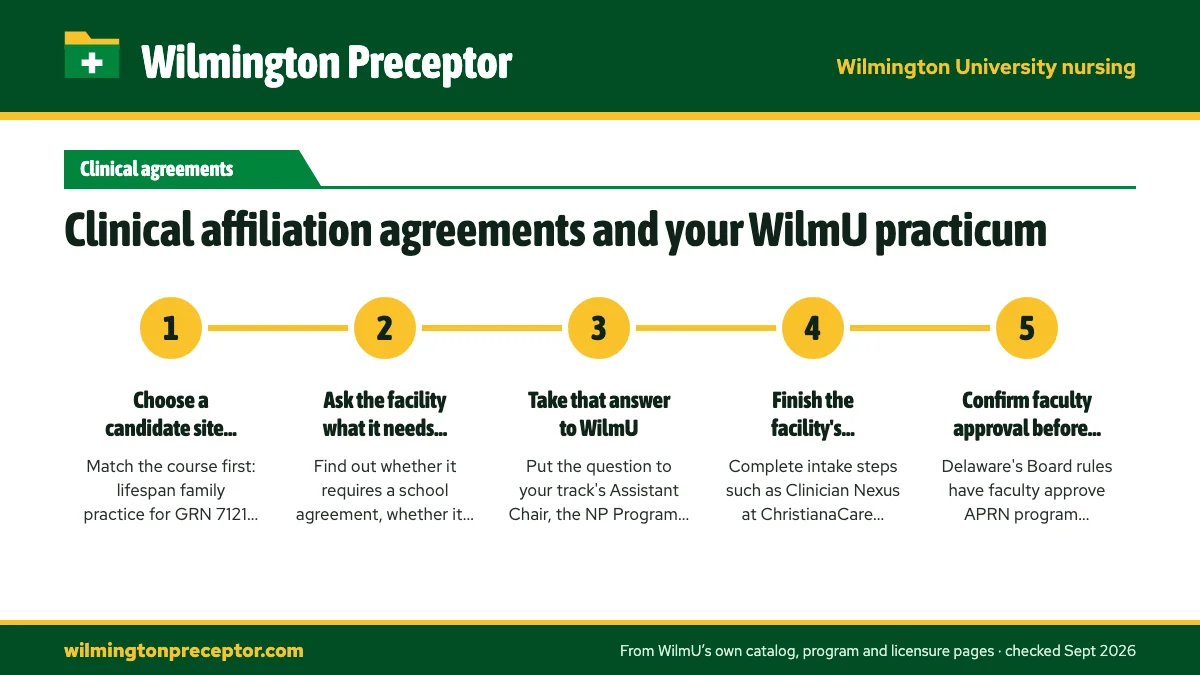
Agreements cost the most calendar time when they come up late. Whoever makes the first call to a site, you or WilmU faculty, the order below keeps the agreement question near the front, while other options are still open.
- Choose a candidate site and clinicianMatch the course first: lifespan family practice for
GRN 7121toGRN 7124, psychiatric care for the PMHNP practicums, a doctorally prepared preceptor for DNP hours. - Ask the facility what it needs from the schoolFind out whether it requires a school agreement, whether it is opening new ones, and which intake system it uses.
- Take that answer to WilmUPut the question to your track's Assistant Chair, the NP Program Chair or, for DNP hours, the DNP Program Chair: is an agreement in place or needed, and what do they need from you to move it along?
- Finish the facility's onboardingComplete intake steps such as Clinician Nexus at ChristianaCare, Bayhealth or Beebe, in step with WilmU's clinical credentialing clearance.
- Confirm faculty approval before hours beginDelaware's Board rules have faculty approve APRN program preceptors. Keep the written confirmation with your course records.
Working somewhere is not the same as an agreement
If you work as an RN inside a health system, it is natural to look there first. ChristianaCare's page is a useful reminder of the limits: its agreement requirement applies to all nursing students, including ChristianaCare's own employees. Being on staff can open a conversation with a clinician, but the student relationship still runs through the school.
The same question matters for the DNP. WilmU notes that DNP Projects are usually based where the student already works, and your experiential engagement preceptor needs a doctorate. Ask the DNP Program Chair or your DNP Project Advisor whether your workplace needs any agreement with WilmU for your practice hours. Raise it before GRN 9001, since that is the course where the Human Subjects Committee reviews your project plan. The DNP preceptor guide covers the preceptor side.
Sites outside Delaware
WilmU's online NP and DNP students live across the country, so the facility may sit in a state with rules of its own. WilmU's state authorization page counts field experiences outside Delaware as part of online learning and promises to meet other states' rules for those experiences. The Online Learning office is the WilmU office for state authorization questions.
Two checks belong beside the agreement question. First, WilmU's NP pages tie every clinical to an RN license valid in the state where you train, as the RN license page explains. Second, that state's board may want paperwork from the school before students arrive, much as Delaware's board does for programs from elsewhere. The out-of-state clinicals guide sets out whom to ask.
How we handle agreements for WilmU students
We treat the agreement as part of the match from day one. Before we bring a WilmU student a preceptor, we have asked the facility whether it needs a school agreement, whether it is taking new ones, and which intake system it runs. You get those answers in writing, ready to hand to your faculty.
That is the difference between a name on a list and a placement that can start on time. We also map the facility's onboarding, line it up with your credentialing clearance and course calendar, and stay on call if a site changes its terms. Approval of each preceptor and site belongs to WilmU faculty; our work is to make the file they open complete from the start. Share your course and start term on the contact page.
Questions WilmU students ask
Does Wilmington University publish a list of its clinical affiliation agreements?
Not for NP or DNP students. The one site list WilmU publishes belongs to the DNP in Nurse Anesthesiology, which names ChristianaCare, Nemours, Bayhealth, Beebe and TidalHealth Peninsula Regional sites. For an NP or DNP practicum, name the facility you have in mind in a note to your program's chair or assistant chair.
Can I contact ChristianaCare about an NP rotation myself?
ChristianaCare's student page wants graduate students to check that their school holds an active affiliation agreement before getting in touch, and it says no new agreements are being signed. Applications run through Clinician Nexus. Before reaching out, ask WilmU faculty what they can confirm about an agreement for your program.
Who signs a clinical affiliation agreement?
The school and the facility sign it; the student is not a party. WilmU's public pages do not name the office that starts or signs its agreements, so the program handbook or the NP Program Chair is the place to ask. Bayhealth's page, for example, describes sending its agreement to a point person the school names.
How long does a new clinical affiliation agreement take?
WilmU publishes no lead time, and each facility sets its own pace. TidalHealth, for instance, asks for preceptorship requests a minimum of 90 days ahead. The safest plan is to raise the agreement question with WilmU as soon as a site becomes a real candidate, well before the semester that holds your practicum.
Does a private practice need an affiliation agreement with WilmU?
Facilities set their own conditions, and nothing on WilmU's public pages settles whether the University needs an agreement with each practice. Ask the NP Program Chair or your Assistant Chair early, giving the practice's name and address, and ask the practice what it expects from the school so both answers arrive together.
Related pages
Last checked 2026-09-27
We check these pages against Wilmington University's own program and curriculum pages, the 2026-27 graduate catalog, the College of Nursing and Health Sciences policies and the State Licensures by Program page. Your NP Program Chair, your course faculty and the College have the final word.
A WilmU practicum coming up? Your preceptor search starts here.
Tell us your WilmU program, where you live and when your next practicum starts. Whether WilmU's faculty help with your placement or you are starting the search yourself, we find preceptors who fit the course, check the health system's own intake steps, and organize the preceptor's license and credentials well before the first day.
- Preceptors matched to the course: family practice across the lifespan for
GRN 7121toGRN 7124, psychiatric mental health forGRN 7221toGRN 7224, doctorally prepared for the DNP - Clinicians who meet Delaware's rule for APRN program preceptors: an active APRN, PA, pharmacist or physician license in a comparable focus
- Close to home, in a state where you hold an RN license, with each system's onboarding mapped out early
Start your placement plan
Program, city and semester is all we need to begin.