Reaching your first Wilmington University practicum, in order
Wilmington University posts no single placement checklist, but its catalog, curriculum pages and College policy set a clear order: finish the courses that come first, complete clinical credentialing clearance, show current CPR and the right RN license, then begin the practicum. Credentialing timing sits in the program handbook WilmU refers to, and several working details of a practicum appear on no public page at all.
Get your placement plan
Tell us your WilmU program and where you live. A placement advisor replies with the preceptor and site options that fit your WilmU course.
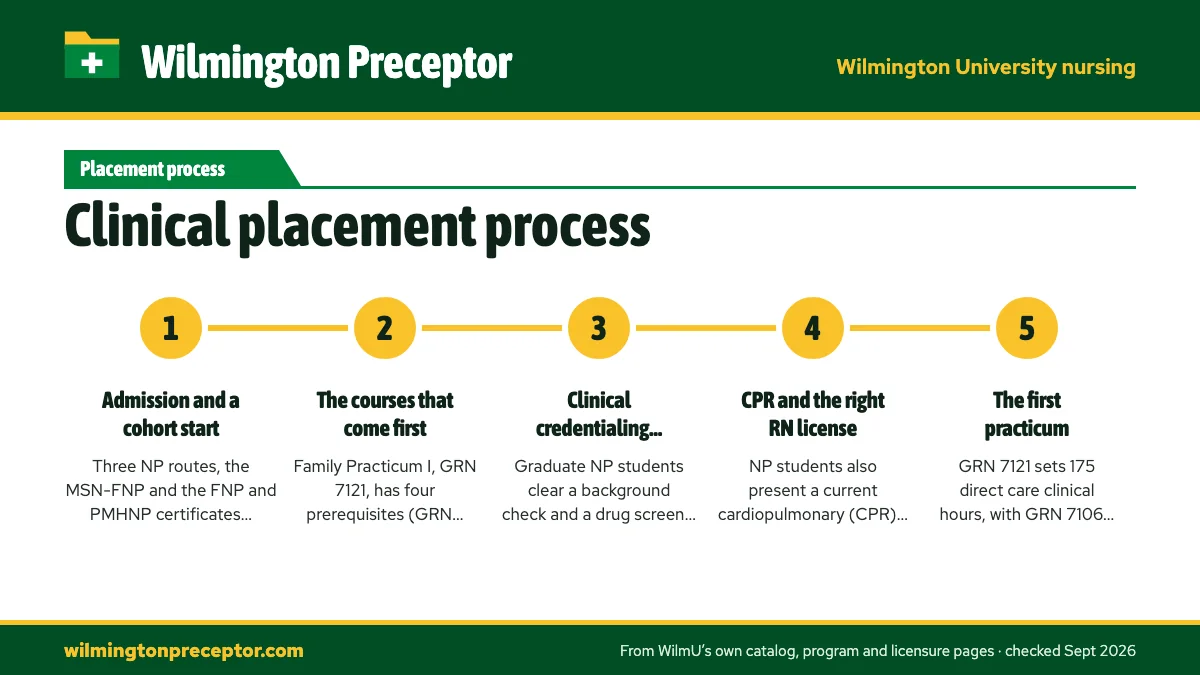
The sequence WilmU's public pages set out
Read together, WilmU's MSN-FNP pages, the 2026-27 graduate catalog and the College of Nursing and Health Sciences credentialing policy give five checkpoints between admission and your first hour with a preceptor. Each one is below, with what the source actually states.
- Admission and a cohort startThree NP routes, the MSN-FNP and the FNP and PMHNP certificates, admit through two stages: an application, then an interview. New cohorts form each Fall and each Spring, with applications closing May 1 (Fall) and October 1 (Spring).
- The courses that come firstFamily Practicum I,
GRN 7121, has four prerequisites (GRN 7101,GRN 7103,GRN 7104,GRN 7105). The third, whose title is Advanced Health Assessment Across the Lifespan, is taught in a clinical laboratory setting. - Clinical credentialing clearanceGraduate NP students clear a background check and a drug screen using the credentialing system the College designates. The program handbook fixes when in the course progression this happens, and the student covers the fees.
- CPR and the right RN licenseNP students also present a current cardiopulmonary (CPR) certification and an RN license good in the state that is hosting the clinical.
- The first practicum
GRN 7121sets 175 direct care clinical hours, withGRN 7106andGRN 7107taken that same term. NP students are covered by a group professional liability policy the University holds.
The MSN-FNP overview sums up the timing in one line: practicum experiences come in the later half of the program. Your own term comes from the course plan in MyWilmU Degree Works.
How the PMHNP, DNP and Leadership routes differ
The PMHNP Graduate Certificate reaches its first practicum by another path. Certificate students must have earned a B or better in each of GRN 7101 to GRN 7104 before they enroll, then take GRN 7201 and GRN 7202, and then open Psychiatric Mental Health Practicum I, GRN 7221, alongside GRN 7203. The PMHNP preceptor guide follows that pairing course by course.
In the DNP, both GRN 8121 and GRN 9001 name current, completed credentialing among their prerequisites. In GRN 9001 the project plan also goes before WilmU's Human Subjects Committee for approval, and practice hours are completed with a doctorally prepared preceptor, described on the DNP preceptor page.
In MSN Nursing Leadership, only the Educator concentration states clinical hours, and it states 32: they sit in MSN 7752, taken with an approved mentor, and that course opens only once clinical clearance is done. The Nursing Leadership Graduate Certificates make clearance mandatory before a student registers for any clinical course.
Why the credentialing policy mentions placement
The one WilmU document that uses the word placement is the College's policy on background checks and drug screens. It says the checks exist to meet what "clinical facilities and contractual agreements" require and to prevent "delays in clinical placement." Clearance, in other words, is the College's answer to what host facilities ask of every student.
Two consequences follow. Anyone who refuses the checks, or whose findings are still unresolved once the College has reviewed them, cannot enroll in clinical courses, which can halt progress toward graduation. And because the policy links clearance to agreements with facilities, a site's own paperwork can matter as much as a clinician's willingness to teach. The clinical credentialing guide and the page on affiliation agreements take each part in turn.
Clearance is a course prerequisite, not a formality: several WilmU catalog entries list it before the course may begin.
What WilmU leaves to the program handbook
WilmU's public pages point to a program handbook for the timing of credentialing, and they say nothing about the working details of an NP practicum. Before you plan around any item below, ask the Assistant Chair who oversees your track or the NP Program Chair, or read the handbook itself.
Not on WilmU's public pages
- The exact point in your course progression when credentialing is due
- Placement forms and what they are called
- Deadlines or lead times for confirming a preceptor or site
- Which WilmU role approves a preceptor or a site
- Site onboarding steps and the system used to log NP hours
- Evaluation forms and site visits for NP practicums
- An immunization list for graduate NP and DNP students
- Any rule for students who relocate mid-program
Delaware's Board of Nursing fills one gap in general terms: the Board's APRN program rules place preceptor approval with faculty. Our guide to the program handbook lists what to look up first, and questions for your program chair turns the open items into a short email.
Timing questions WilmU answers two ways
Some planning facts are unstated, and some are stated differently from one WilmU page to another. The MSN-FNP curriculum page and catalog say the program can be finished in 24 months, while the overview says 7 semesters. That overview also mentions practicum students meeting face to face for two seminars each year, even though its format line reads Online only, and it gives no location for them.
WilmU's academic year runs three 15-week semesters and six 7-week blocks, each block followed by a reading week, but no page says which format the NP practicum courses use. That decides how many weeks you have for 175 hours. The Fall 2026 semester spans August 31 through December 13, and Spring 2027 spans January 11 through May 2. The academic calendar has the block dates; confirm your practicum's format with course faculty.
Where we come in
WilmU students choose us because we work to this exact sequence. Once you know which term your first practicum falls in, we look for a preceptor matched to that GRN course, within reach of home and inside a state your license already covers, then put the clinician's license record, credentials and contact information into one file before the course opens.
We also map each health system's intake early, such as the Clinician Nexus onboarding that ChristianaCare, Bayhealth and Beebe describe on their own pages, and we remain available to line up a replacement should a preceptor step away mid-course. Each preceptor and site is WilmU faculty's decision to make, so what we hand over is complete before it reaches them. Tell us your course and start term to begin.
Questions WilmU students ask
When does the first clinical course fall in WilmU's MSN-FNP?
Family Practicum I comes after its four prerequisite courses, in the term when you also take GRN 7106 and GRN 7107. WilmU's overview puts practicums in the later half of the program. Your cohort start and the plan shown in MyWilmU Degree Works fix the exact term, so check it there first.
Does WilmU publish a deadline for confirming a preceptor?
No deadline or lead time appears on WilmU's public pages, so raise it with the NP Program Chair or look in the program handbook. Health systems keep their own clocks: TidalHealth, for example, wants its preceptorship request form 90 or more days ahead of the start and then locates the provider itself.
Do I buy my own liability insurance for WilmU clinicals?
According to WilmU's MSN-FNP curriculum page, NP students fall under a group professional liability policy held by the University. Whether a particular site asks for anything beyond that is a question for the site and your course faculty. The same curriculum page also sets the CPR condition that applies before any clinical experience.
Is clinical credentialing clearance the same as a site's onboarding?
No. Clearance is WilmU's own requirement, handled in the credentialing system the College designates. Health systems often add steps of their own: Beebe Healthcare's onboarding in Clinician Nexus, for instance, covers vaccines, a fit test, a drug test, a background check and a Delaware Adult and Child Protection Registry search before the rotation.
Where can I read WilmU's program handbook?
WilmU's pages refer to the program handbook but do not post it publicly. Your course faculty or your NP program leaders can tell you where the current edition is kept. Read its credentialing section first, since that is the part WilmU's public policy sends you to.
Related pages
Last checked 2026-09-27
We check these pages against Wilmington University's own program and curriculum pages, the 2026-27 graduate catalog, the College of Nursing and Health Sciences policies and the State Licensures by Program page. Your NP Program Chair, your course faculty and the College have the final word.
A WilmU practicum coming up? Your preceptor search starts here.
Tell us your WilmU program, where you live and when your next practicum starts. Whether WilmU's faculty help with your placement or you are starting the search yourself, we find preceptors who fit the course, check the health system's own intake steps, and organize the preceptor's license and credentials well before the first day.
- Preceptors matched to the course: family practice across the lifespan for
GRN 7121toGRN 7124, psychiatric mental health forGRN 7221toGRN 7224, doctorally prepared for the DNP - Clinicians who meet Delaware's rule for APRN program preceptors: an active APRN, PA, pharmacist or physician license in a comparable focus
- Close to home, in a state where you hold an RN license, with each system's onboarding mapped out early
Start your placement plan
Program, city and semester is all we need to begin.