WilmU's DNP Leadership concentration and experiential engagement
Wilmington University's Leadership concentration is the longer of its two DNP routes: 45 credits and 1,000 practice experience hours. It opens with four experiential engagement courses, each filling its own 15-week semester, then moves into the three DNP Project courses, all of them completed beside a doctorally prepared preceptor. We find preceptors whose work matches the leadership focus you shape with DNP faculty.
Get your placement plan
Tell us your WilmU program and where you live. A placement advisor replies with the preceptor and site options that fit your WilmU course.
The concentration by the numbers
WilmU's curriculum page and catalog give the Leadership concentration more moving parts than Advanced Practice, because its practice hours start well before the project does.
| Piece | What WilmU lists |
|---|---|
| Credits | 45 |
| Practice experience hours | 1,000 |
| Bridge course | MSN 7710 for students missing advanced pathophysiology, pharmacology and physical assessment |
| Experiential engagement | GRN 8121, GRN 8122, GRN 8123, GRN 8124: 125 hours and 3 credits each, one at a time, in 15-week semesters |
| DNP Project | GRN 9001 (about 145 hours), GRN 9002 (about 145), GRN 9003 (about 150), under continuous enrollment |
| Earlier graduate hours | Credit may be given for practicum or clinical hours from earlier graduate coursework |
The four experiential courses account for 500 hours between them. How the project courses and any credit for earlier graduate hours complete the 1,000 is best settled with the DNP Program Chair; the DNP practice hours page compares every hour rule WilmU publishes.
What experiential engagement means at WilmU
Experiential engagement is WilmU's name for the Leadership concentration's practice courses. The catalog says GRN 8121 to GRN 8124 are completed with an experiential engagement preceptor, and it adds a line that matters for planning: "The content of the practicum will be defined by the student in consultation with DNP faculty."
Put simply, you help write your own practicum. The focus you settle with DNP faculty decides which kind of doctorally prepared leader makes sense as a preceptor, what setting you work in and what you produce across the four courses.
Because each course fills a 15-week semester and the four are taken one at a time, experiential engagement is a long relationship. Spread evenly, 125 hours over fifteen weeks averages a little over eight hours a week, which sits beside a full-time job but still calls for a preceptor with steady availability. The experiential engagement guide covers the four courses one by one.
Matching a preceptor to your leadership focus
The right preceptor follows from the focus. A student working on nursing workforce policy needs a different mentor from one redesigning a patient education program, and both differ from a student building a community health initiative. WilmU's rule is doctoral preparation; fit with your focus is what makes the hours productive.
Students arriving from WilmU's MSN in Nursing Leadership can carry a concentration forward: Executive, Educator, Legal Nurse Consultant, Nursing Professional Development or Public Health. Each points to a different pool of doctorally prepared leaders, from nurse executives and academic faculty to public health administrators.
When we search for a Leadership student, we begin with the focus you and DNP faculty agreed on, search for leaders holding doctorates whose present work lines up with it, then check that they can commit across several semesters rather than a single course.
Coming from MSN Leadership, a certificate or an MBA
Several WilmU routes change the Leadership concentration's credit total while keeping its practice structure.
- MSN Leadership to DNP, accelerated: WilmU's accelerated option lowers the doctorate's credit count to 39 or 36, down from 45. The MSN in Nursing Leadership page covers the master's side.
- Leadership certificate + DNP: any of the four leadership-side certificates (Nurse Executive, Nurse Educator, Public Health, Legal Nurse Consultant) on the Leadership path comes to 60 credits and 1,000 hours, and Educator students also take
MSN 7752. See certificate + DNP. - DNP + MBA in Healthcare Administration: the Leadership path runs 66 credits and 1,000 hours, including all four experiential engagement courses before the project.
Each combination keeps the doctorally prepared preceptor requirement and all four experiential engagement courses, so the preceptor planning below applies to every one of them.
Planning four semesters of experiential engagement
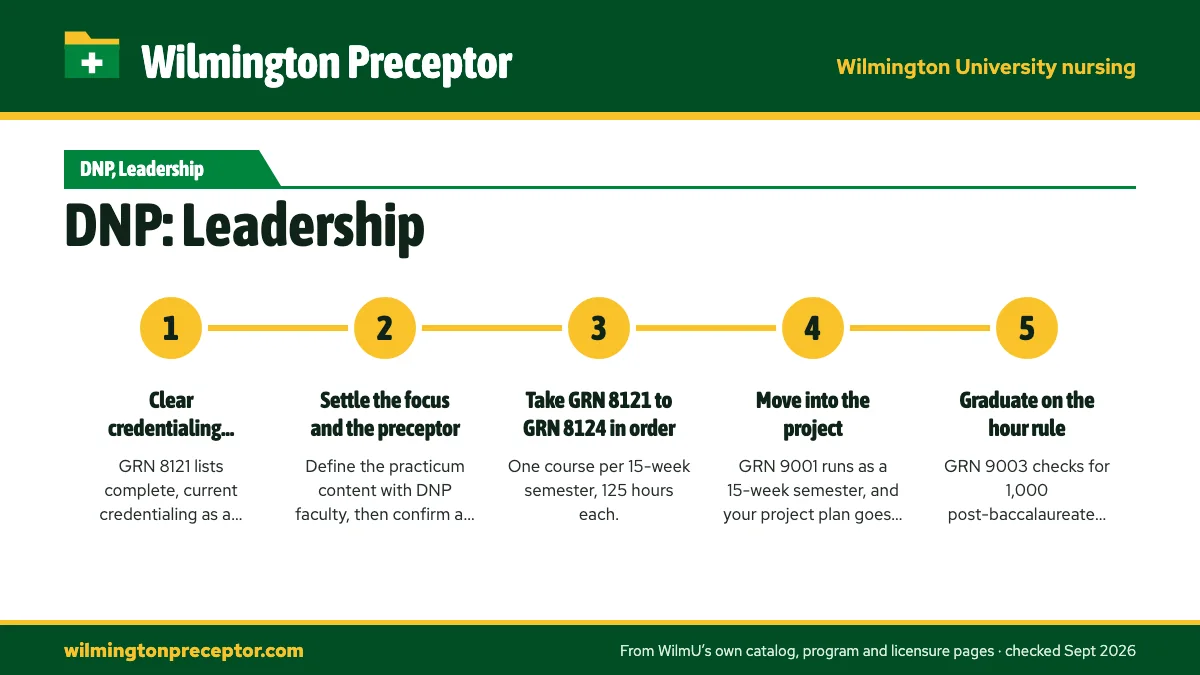
- Clear credentialing first
GRN 8121lists complete, current credentialing as a prerequisite, so wrap up the College's background check and drug screen before the first semester. - Settle the focus and the preceptorDefine the practicum content with DNP faculty, then confirm a doctorally prepared preceptor who fits it.
- Take GRN 8121 to GRN 8124 in orderOne course per 15-week semester, 125 hours each.
- Move into the project
GRN 9001runs as a 15-week semester, and your project plan goes to the Human Subjects Committee for approval there;GRN 9002andGRN 9003follow in 7-week blocks. - Graduate on the hour rule
GRN 9003checks for 1,000 post-baccalaureate practice hours, the finished project and its presentation.
Whether one preceptor carries you through all four experiential courses, or you change mentors as your focus develops, is something to settle with your DNP Project Advisor. We plan for either case: a preceptor who can commit across the semesters, or a handoff arranged before the next course opens.
Why a preceptor gap can cost a full semester
Timing weighs heavily in the Leadership concentration because the experiential engagement courses run only as 15-week semesters, one at a time. Any slip in that sequence is measured in semesters rather than 7-week blocks.
WilmU's academic rules raise the stakes. Each DNP course requires at least a B; a grade under B earns one retake, and the program stops allowing repeats after two courses. Finishing is capped at five years on the curriculum page (the undated packet mentions seven), and the graduate catalog places any student below a 3.0 cumulative GPA on academic probation.
None of this is cause for alarm. It is a reason to confirm your preceptor before GRN 8121 opens rather than partway through it. If a late start has already moved your timeline, the delayed graduation page sets out the options.
Why WilmU Leadership students choose us
Leadership preceptors rarely appear on any clinic list. The doctorally prepared executive, educator or policy leader who fits your focus may work in a different organization from yours, or in a different county. Whether DNP faculty point you to a candidate or you are starting from a blank page, we build the shortlist, make the approach and confirm availability for the semesters you need.
You receive a preceptor file with the license, doctoral degree, role and contact details faculty will review. Final approval of each preceptor and site belongs to WilmU faculty; our job is handing them a file with nothing missing when they first open it.
Across four experiential semesters and three project courses, we stay reachable. If a preceptor changes roles, we line up a successor promptly so your next course has one in place. Read how it works or describe your focus and planned start in the form below.
Questions WilmU students ask
How long is each WilmU experiential engagement course?
WilmU's catalog gives every experiential engagement course, from GRN 8121 through GRN 8124, 125 hours and 3 credits. The courses run in 15-week semesters, one at a time, and belong to the Leadership concentration only. Together they make 500 hours before the DNP Project courses begin.
What is MSN 7710 in WilmU's DNP?
WilmU's curriculum page adds MSN 7710 to the Leadership concentration when a student's record lacks advanced pathophysiology, pharmacology and physical assessment. The Advanced Practice concentration, at 33 credits, is WilmU's route for master's-prepared nurses who hold current national APRN certification.
Can earlier graduate clinical hours count toward WilmU's DNP Leadership hours?
Possibly. According to the curriculum page, practicum or clinical hours completed in earlier graduate study may earn credit. How many carry over, and what documentation you need, is a question for the DNP Program Chair, so bring your transcripts and any hour records to that conversation early.
Do WilmU's experiential engagement courses run in 7-week blocks?
No. The 7-week blocks are for the DNP core; experiential engagement and GRN 9001 each take a full 15-week semester. For 2026-27, those semesters are Fall (August 31 to December 13), Spring (January 11 to May 2) and Summer (May 10 to August 23).
Who decides what I do during experiential engagement?
Largely you do, together with DNP faculty: the catalog leaves the practicum's content for the student to shape in consultation with them. You propose a focus, faculty help shape it, and your experiential engagement preceptor guides the work where it happens. WilmU faculty keep the final word on the preceptor and the setting.
Related pages
Last checked 2026-09-27
We check these pages against Wilmington University's own program and curriculum pages, the 2026-27 graduate catalog, the College of Nursing and Health Sciences policies and the State Licensures by Program page. Your NP Program Chair, your course faculty and the College have the final word.
A WilmU practicum coming up? Your preceptor search starts here.
Tell us your WilmU program, where you live and when your next practicum starts. Whether WilmU's faculty help with your placement or you are starting the search yourself, we find preceptors who fit the course, check the health system's own intake steps, and organize the preceptor's license and credentials well before the first day.
- Preceptors matched to the course: family practice across the lifespan for
GRN 7121toGRN 7124, psychiatric mental health forGRN 7221toGRN 7224, doctorally prepared for the DNP - Clinicians who meet Delaware's rule for APRN program preceptors: an active APRN, PA, pharmacist or physician license in a comparable focus
- Close to home, in a state where you hold an RN license, with each system's onboarding mapped out early
Start your placement plan
Program, city and semester is all we need to begin.