WilmU DNP practice hours: 500, 1,000 and the overview's 1,500
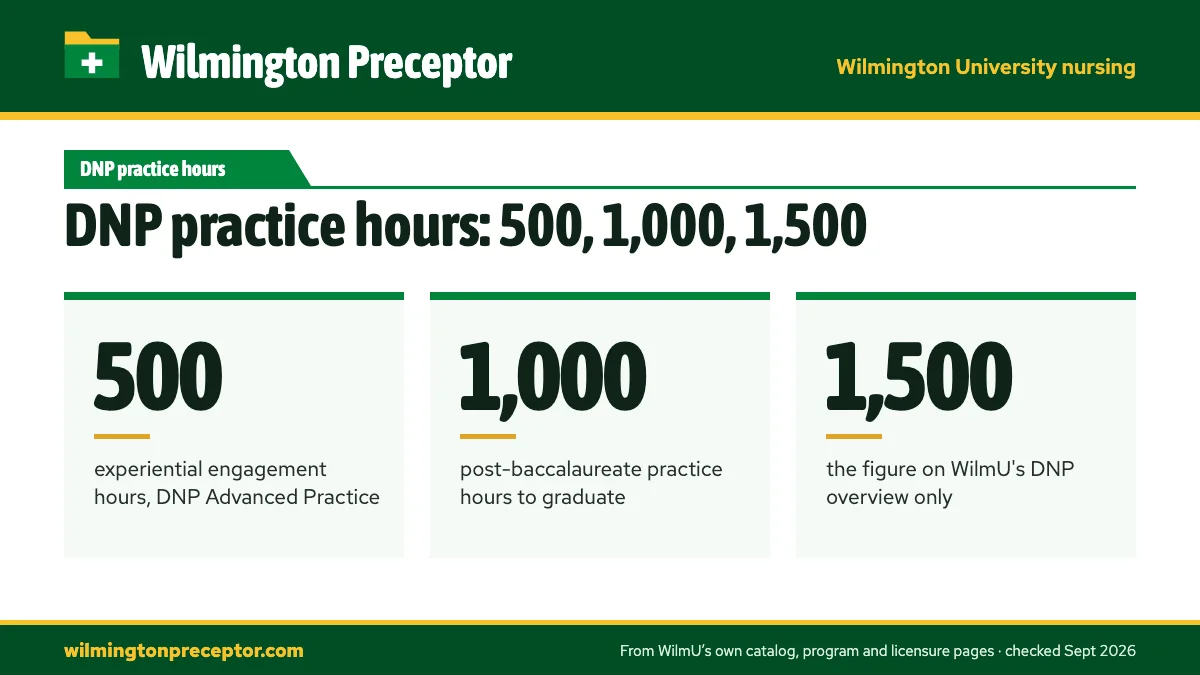
Wilmington University counts DNP practice hours at two levels. Each concentration sets what you complete at WilmU, 500 hours for Advanced Practice and 1,000 for Leadership, and every graduate must reach a floor of 1,000 practice hours earned after a baccalaureate. A third number, 1,500, shows up on the DNP overview for advanced practice nurses and nowhere else in WilmU's DNP material. This page sets the figures side by side and shows what to confirm before you plan preceptor time.
Get your placement plan
Tell us your WilmU program and where you live. A placement advisor replies with the preceptor and site options that fit your WilmU course.
Every DNP hour figure WilmU publishes
WilmU states practice hours route by route, and the totals only make sense side by side. Credits are shown for context; the hour column is what drives your preceptor planning.
| Route | Credits | Hours WilmU lists |
|---|---|---|
| DNP, Advanced Practice concentration | 33 | 500 experiential engagement hours (1,500 on the overview) |
| DNP, Leadership concentration | 45 | 1,000 practice experience hours |
| FNP Graduate Certificate + DNP | 75 | 750 + 500 |
| PMHNP Graduate Certificate + DNP | 60 (72 for non-APRNs) | 750 + 500 |
| Legal Nurse Consultant, Nurse Educator, Nurse Executive or Public Health certificate + DNP | 48 (APRN) or 60 (Leadership) | 500 or 1,000 |
| DNP + MBA in Healthcare Administration | 54 (APRN) or 66 (Leadership) | 500 or 1,000 |
| Ph.D./DNSc to DNP | Individualized | 1,000 post-baccalaureate, 500 credited to board-certified APRNs |
| BSN to DNP, FNP or PMHNP track | 75 or 79 | 750 NP clinical hours plus DNP practice hours; total not stated |
The rule underneath: 1,000 post-baccalaureate hours
WilmU's catalog entry for GRN 9003 spells out what graduation takes: the DNP Project, its presentation, and a full 1,000 practice hours accumulated after the bachelor's degree. "Post-baccalaureate" is the key word. Hours earned after your BSN, including clinical hours from a master's program, sit inside that definition.
The Ph.D./DNSc to DNP page shows the arithmetic most plainly: board-certified APRNs arrive with 500 of the 1,000 already credited. Read that way, the Advanced Practice concentration's 500 hours are the half you complete at WilmU, with your earlier advanced practice education covering the rest. For the Leadership concentration, WilmU's wording points the same direction, allowing credit for practicum or clinical time from prior graduate study.
What WilmU leaves unpublished is how that credit is documented or reviewed. Confirm it with the DNP Program Chair before you count on it, and see the DNP Advanced Practice and DNP Leadership guides for the rest of each concentration.
The 1,500 on the DNP overview
WilmU's DNP overview page tells advanced practice nurses they will complete 1,500 hours. Three other WilmU sources, the curriculum page, the DNP admission page and the 2026-27 catalog, give 500. Nothing on WilmU's public pages explains the difference, so treat it as an open conflict rather than choosing the figure you prefer.
The gap is too large to ignore. If 1,500 applied, an Advanced Practice student would need a thousand more hours with a preceptor, which changes how long you need a practice site and how much time you need away from work. Ask the DNP Program Chair which figure governs your cohort, and keep the reply from your MyWilmU student email with your admission documents.
The overview is not the only place where WilmU's DNP figures drift. It gives the program length as 28 months, the curriculum page says 25, and a packet for applicants that carries no date puts it anywhere from 20 to 28, so check any number you plan around against the curriculum page and catalog.
Plan preceptor time from the figure the DNP Program Chair confirms in writing, not from whichever WilmU page you read first.
Where the course hours fall short of the totals
Taken one by one, WilmU's three project courses list roughly 145 hours for GRN 9001, 145 for GRN 9002 and 150 for GRN 9003. That sums to about 440, not the 500 the Advanced Practice concentration names. Leadership students add 500 more through the experiential engagement courses, for a combined figure near 940 set against a required 1,000.
WilmU does not publish how the remaining hours are earned or recorded. Before your first project course, ask how the remaining hours are counted, which course they are logged under, and whether your preceptor signs for them. The answer also tells you how many hours to ask a preceptor to commit to, which is hard to change once a semester is underway. The DNP Project courses page covers the pace of those three courses.
BSN to DNP: 750 NP hours, then DNP hours
The BSN to DNP tracks list 750 FNP or PMHNP clinical hours plus additional DNP practice experience hours, and WilmU's pages give no combined total. The 750 NP hours are earned after your BSN, so they are post-baccalaureate by definition, yet whether and how they count toward the 1,000-hour graduation rule is not stated.
That question decides how many DNP hours you still owe after GRN 7124 or GRN 7224, and it is worth settling before the NP practicums end. On these tracks the NP Program Chair and the DNP Program Director advise together, so put the question to both of them. The clinical hours overview shows the NP practicum hours course by course.
Questions to settle before your first DNP practice course
- Is my required total 500, 1,000 or 1,500 hours, and where is that written?
- Which of my earlier graduate clinical hours count toward the 1,000, and what proof do you need?
- How are hours beyond the course totals earned and logged?
- For BSN to DNP: do my 750 NP hours count toward the 1,000?
- Does every hour need a doctorally prepared preceptor's sign-off?
- Does credit for earlier hours change which DNP courses I take, or only the hour count?
Have your master's transcript and any record of clinical hours from your earlier program ready when you ask, so a credit question can be answered against real numbers. Sending the questions in a single message to the DNP Program Chair keeps the answers together in one reply.
How we plan preceptor time around the right total
Whether your placement runs through WilmU faculty or through inquiries you have opened, we build your preceptor plan from the hour total the DNP Program Chair confirms, then find a doctorally prepared preceptor with the capacity to cover it. A 500-hour Advanced Practice plan and a 1,000-hour Leadership plan call for very different commitments, and we match the preceptor to the one you actually have. For Advanced Practice students that means a preceptor for the three project courses and any balance WilmU confirms; for Leadership students, one preceptor or a planned series across as many as seven courses.
The preceptor's doctoral credential and contact details arrive organized for DNP faculty review, and if a preceptor drops out before your hours are complete, we line up the next one. Send your concentration and expected first practice term using the contact form.
Questions WilmU students ask
How many practice hours is WilmU's DNP?
It depends on the concentration. Advanced Practice is set at 500 experiential engagement hours across WilmU's curriculum, admission and catalog pages, while the overview alone says 1,500. Leadership sets 1,000 practice experience hours. Every graduate needs 1,000 post-baccalaureate practice hours in total.
Does WilmU count my master's NP clinical hours toward the DNP?
WilmU's Ph.D./DNSc to DNP page credits 500 hours to board-certified APRNs toward the 1,000-hour total, and for Leadership students the curriculum wording allows credit for clinical or practicum time from prior graduate work. How the credit is documented is not published, so confirm it with the DNP Program Chair.
Why does WilmU's DNP overview say 1,500 hours?
WilmU's public pages do not explain it. The overview's 1,500 conflicts with the 500 that the curriculum page, the DNP admission page and the catalog all give for the Advanced Practice concentration. Ask the DNP Program Chair which figure applies to your cohort and keep the answer in writing.
How many hours are in WilmU's DNP Leadership concentration?
1,000 practice experience hours across 45 credits. The four experiential engagement courses carry 125 hours apiece, and the project courses list roughly 145, 145 and 150. Earlier graduate practicum hours may be credited; ask the DNP Program Chair how, and what documentation to send.
Related pages
Last checked 2026-09-27
We check these pages against Wilmington University's own program and curriculum pages, the 2026-27 graduate catalog, the College of Nursing and Health Sciences policies and the State Licensures by Program page. Your NP Program Chair, your course faculty and the College have the final word.
A WilmU practicum coming up? Your preceptor search starts here.
Tell us your WilmU program, where you live and when your next practicum starts. Whether WilmU's faculty help with your placement or you are starting the search yourself, we find preceptors who fit the course, check the health system's own intake steps, and organize the preceptor's license and credentials well before the first day.
- Preceptors matched to the course: family practice across the lifespan for
GRN 7121toGRN 7124, psychiatric mental health forGRN 7221toGRN 7224, doctorally prepared for the DNP - Clinicians who meet Delaware's rule for APRN program preceptors: an active APRN, PA, pharmacist or physician license in a comparable focus
- Close to home, in a state where you hold an RN license, with each system's onboarding mapped out early
Start your placement plan
Program, city and semester is all we need to begin.